Executive Summary
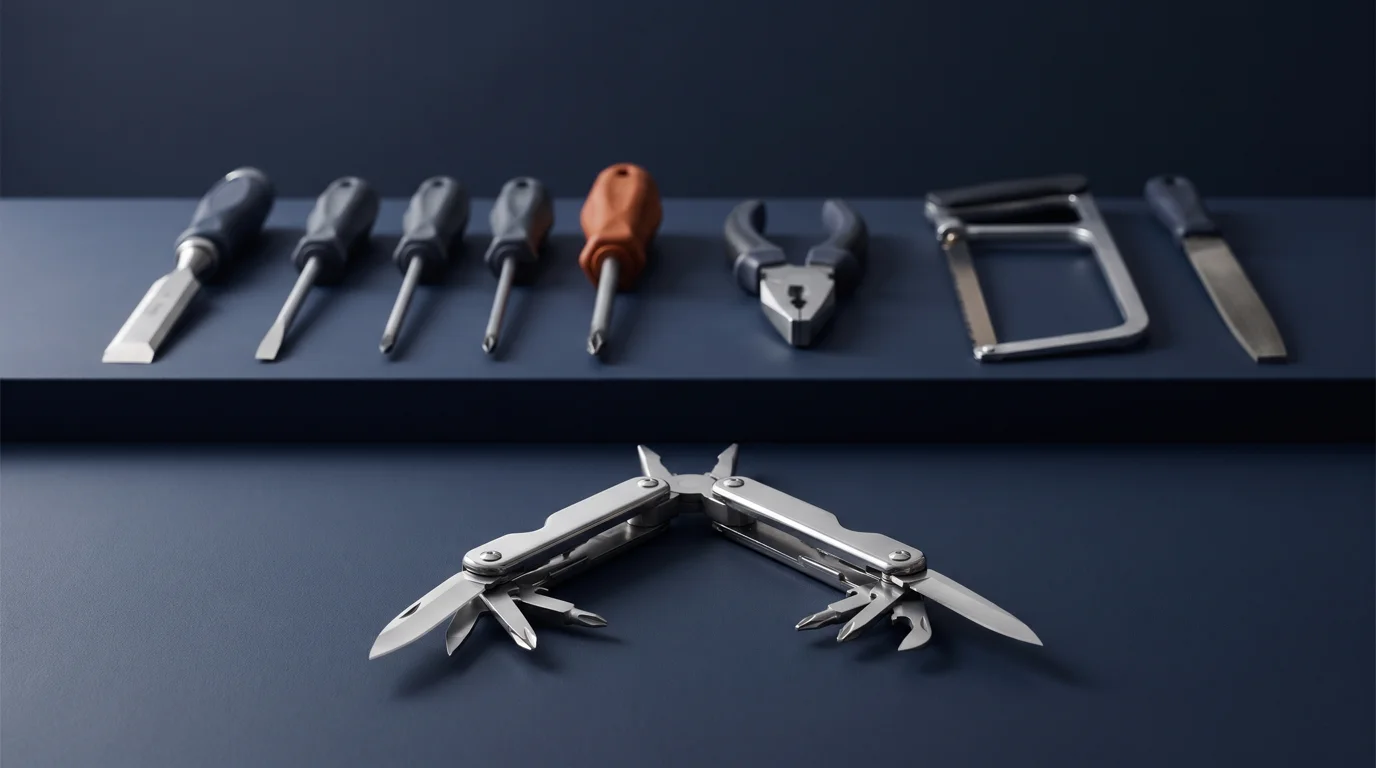
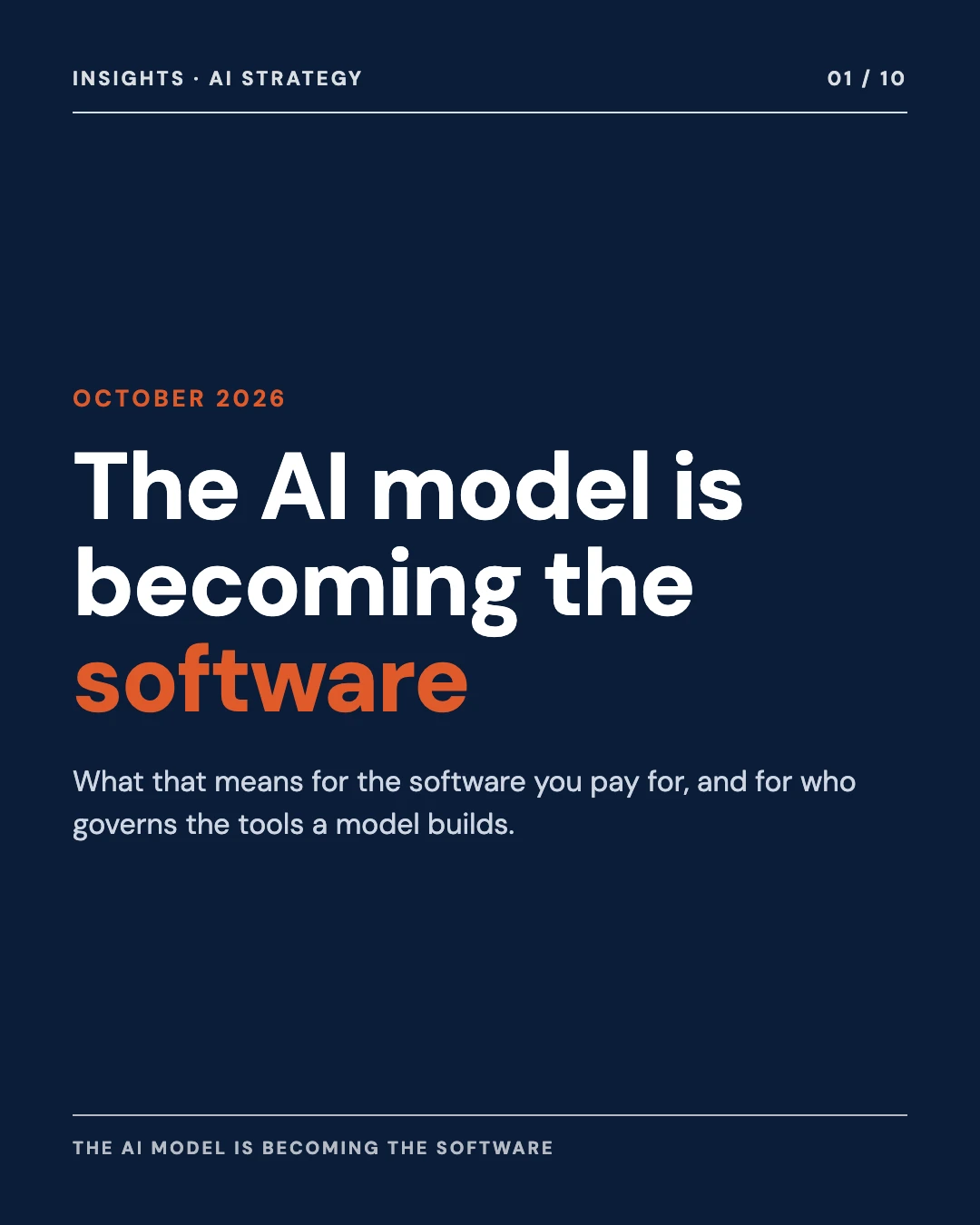
A recent video by Corey McClain argues that AI models are absorbing the software we pay for. October 2026 gave that argument real evidence. A single developer released seven open-source alternatives to Adobe’s main applications, written with Claude. OpenAI added documents and slides to ChatGPT, and Anthropic added animation and live dashboards to Claude, within 17 days of each other. The pattern resembles what smartphones did to compact cameras: most people will settle for software that is good enough and already in the AI subscription they pay for. Dedicated tools will stay with the professionals who need their depth. For an enterprise, the harder question is who governs the software a model builds on demand, because that software still needs an owner, an audit trail and someone to fix it.
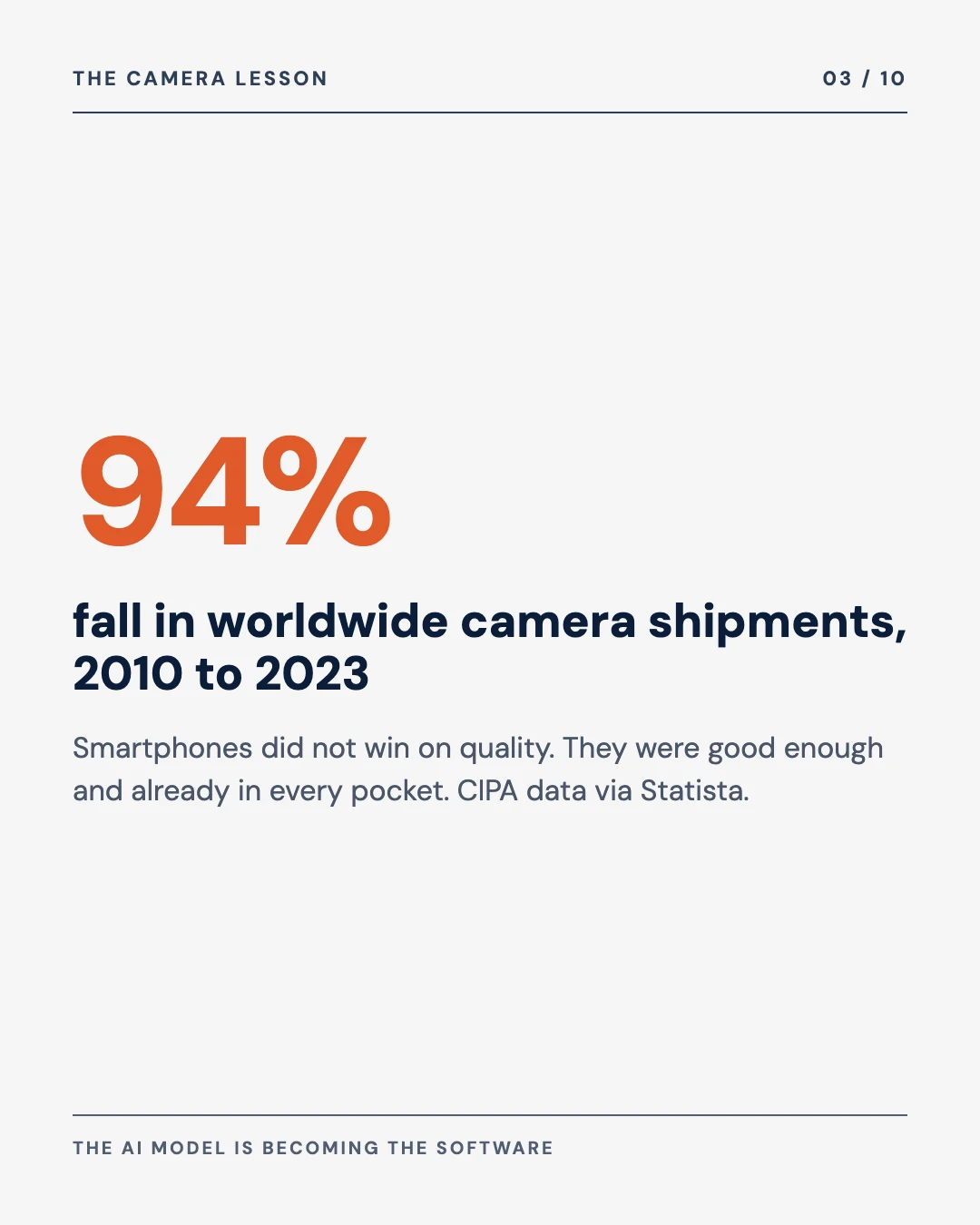
94%
fall in worldwide camera shipments between 2010 and 2023 as smartphone cameras became good enough, CIPA data via Statista
7
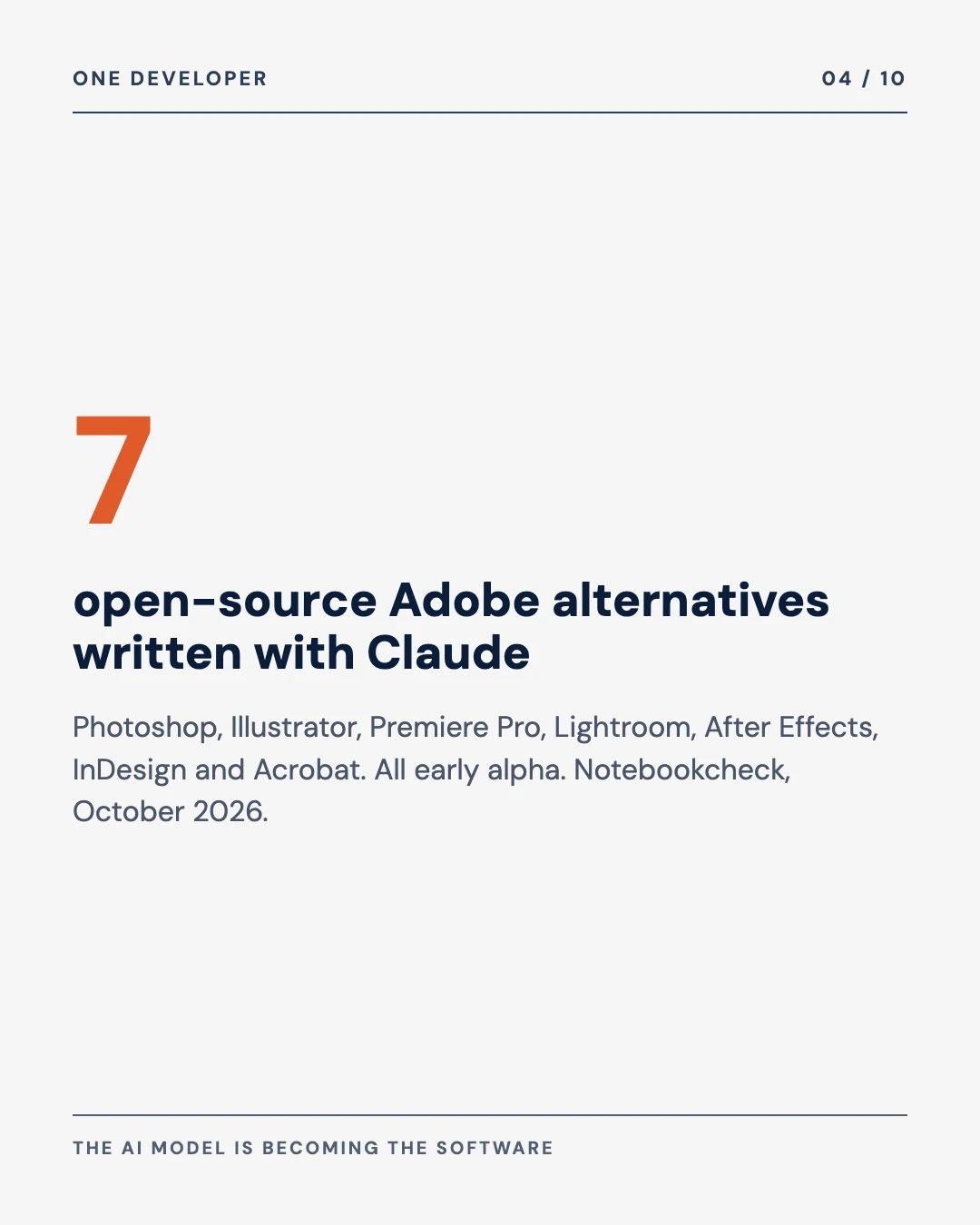
open-source Adobe alternatives released by one developer using Claude Opus 5.5, all in early alpha, October 2026
17 days
between OpenAI announcing Pages on 29 September and releasing Slides on 16 October, with Anthropic’s Claude Motion launching on 8 October in between
18%
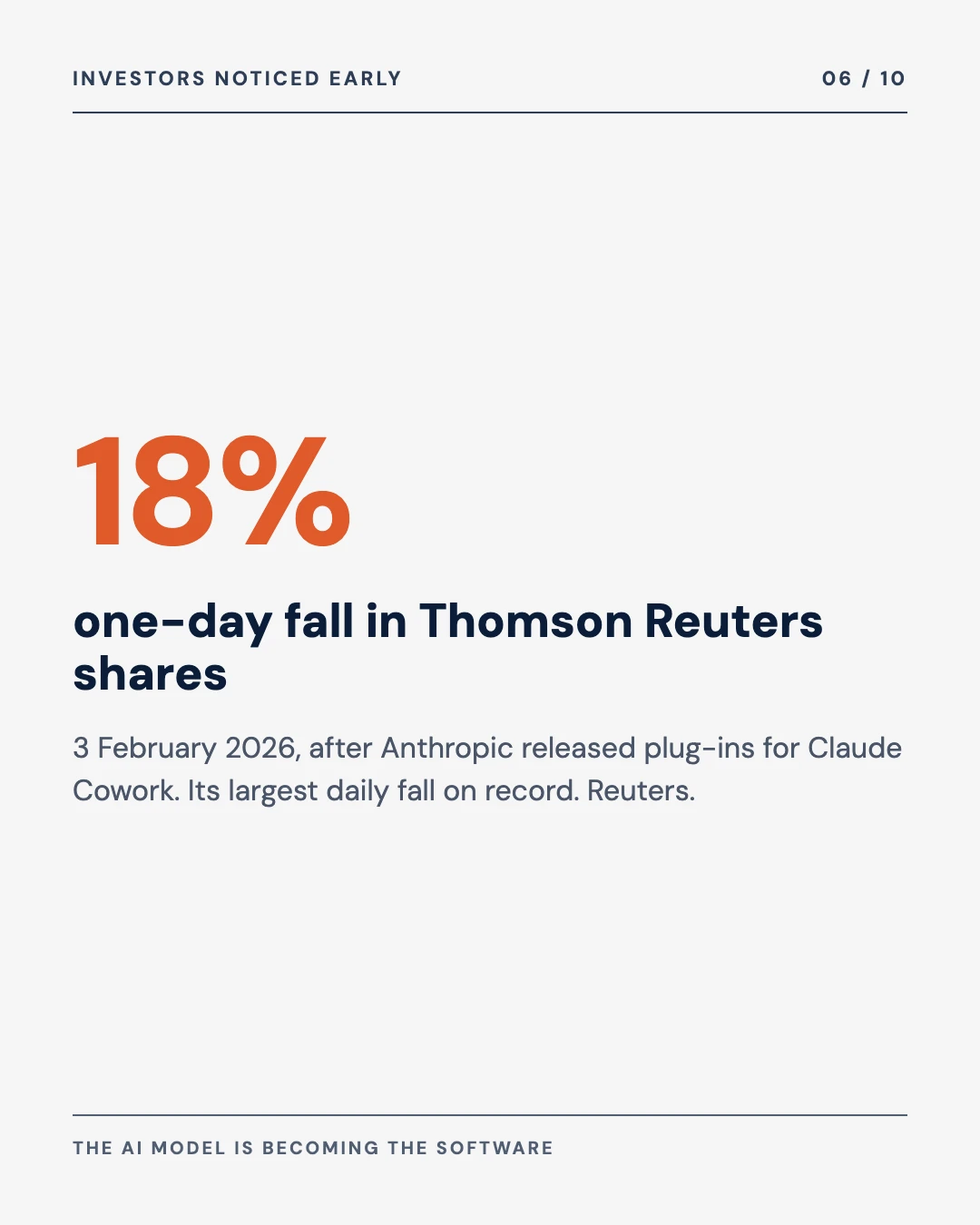
one-day fall in Thomson Reuters shares on 3 February 2026, its largest on record, after Anthropic released plug-ins for its Claude Cowork agent, Reuters
Core conclusions
- The software most at risk is the kind people use lightly: occasional design, simple video edits, basic documents and presentations. AI subscriptions already cover most of that well enough.
- Products that only put a user interface on top of someone else’s model have the weakest position. The model owner can ship the same feature directly to every user it already has.
- Software that a model builds on demand still needs ownership, version control, access rights and a fix when it breaks. Enterprises that let it spread without those controls are building unmanaged software at scale.
The argument, in ten slides
Save it, or send it to whoever owns your software renewals.

The argument in the video
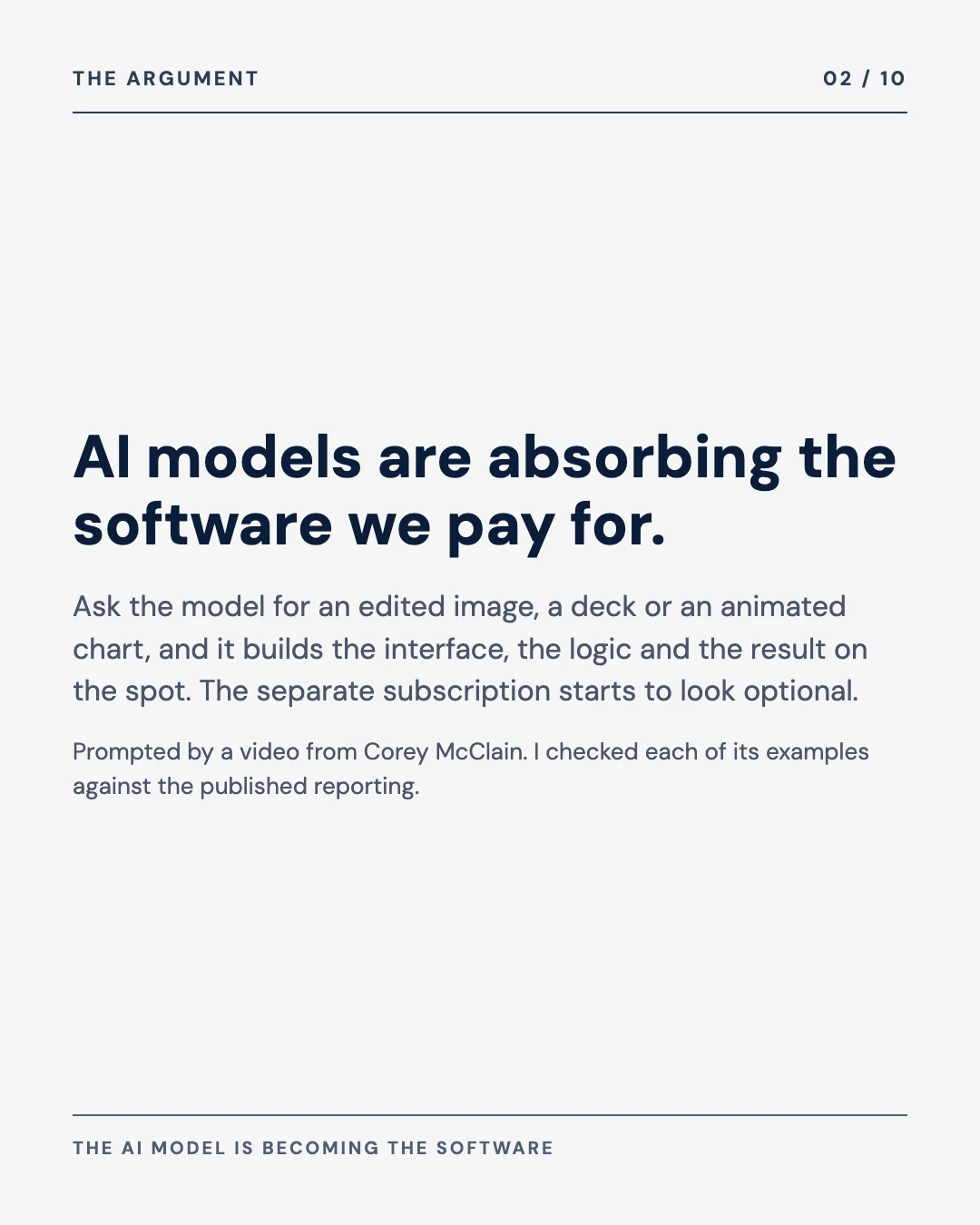
Corey McClain’s video makes one central claim. AI models are no longer tools that sit inside software. They are becoming the software. A person who needs an image edited, a presentation drafted or a chart animated can ask the model directly, and the model produces the interface, the logic and the result on the spot. The separate subscription stops looking necessary.
I think the claim is mostly right, and it deserves to be taken seriously by anyone who signs software contracts. Some of the details in the video run ahead of the evidence, so I checked each example against what was published. What holds up is still significant.
What happened in October 2026
Seven Adobe alternatives from one developer. Brandon Thomas, who runs a project called ArtCraft, released open-source versions of Photoshop, Illustrator, Premiere Pro, Lightroom, After Effects, InDesign and Acrobat, first reported on 7 October. He wrote them in Rust with Claude Opus 5.5 as his coding assistant and calls them a clean-room reimplementation. Reviewers describe them as early alpha. The Photoshop-style app handles basic tasks, and the video editor still lags and has audio problems. Whether the work avoids Adobe’s patents has not been tested. Even so, a single person producing seven working applications of this scope would have been unthinkable two years ago.
A toolkit that lets an AI agent study any application. REA, short for Reverse Engineer Anything, is an open-source toolkit released on 7 October that connects AI agents to disassemblers such as Ghidra, Hopper and IDA. An agent can inspect a compiled application without its source code, explain how a feature works and build a similar feature for your own product. It does not claim to recover original source code or clone an application automatically. It does lower the cost of understanding how someone else’s software works, which used to be a specialist job.
Office and design features inside the chat window. At its DevDay event on 29 September, OpenAI announced Space, a shared workspace in ChatGPT, and Pages, a word processor built for people and AI agents to work on together. Slides followed on 16 October for Pro, Business and Enterprise users, with export to PowerPoint, PDF and Google Slides. On 8 October, Anthropic released Claude Motion, which writes code to produce animated explainers and charts and exports them as video, alongside Claude Dashboards, which builds live dashboards from a company’s data warehouse. Claude’s documents, slides and design features came out of beta the same day.
The video also mentions an OpenAI spreadsheet product. I could not find a confirmed launch, so I have left it out.
Software features released by AI labs and AI-assisted builders
Sources: TechCrunch, 29 September 2026; REA on GitHub; PetaPixel and Notebookcheck, 7 and 8 October 2026; Unite.AI, October 2026; OpenAI release notes, 16 October 2026.
Investors had already priced in the fear. On 3 February 2026, after Anthropic released plug-ins that automate legal, sales, marketing and data-analysis work, Thomson Reuters shares fell nearly 18 percent in a day, the largest fall in its history. RELX fell 14 percent and Wolters Kluwer about 13 percent. One fund manager told Reuters that the market “just shoots first and asks questions later.” Markets often overreact, but the reaction shows how seriously large investors take the idea.
The camera lesson
The video’s best point is an analogy. Between 2010 and 2023, worldwide camera shipments fell by 94 percent, according to data from CIPA, the Japanese camera industry association. Shipments of compact cameras with built-in lenses fell from almost 109 million to 1.7 million. Smartphones did not beat dedicated cameras on quality. They won because their cameras were good enough, and because they were already in everyone’s pocket.
Compact camera shipments after the smartphone
Compact cameras with built-in lenses shipped by CIPA members, bars to scale. Source: CIPA data, charted by Statista and reported by PetaPixel, August 2024.
Dedicated cameras survived. Professionals and serious hobbyists still buy them, and the market has stabilised at a much smaller size. The mass market left and did not come back.
Software is likely to follow the same path. A marketing manager who edits five images a month does not need Photoshop if the AI subscription the company already pays for can do it well enough. A retoucher who edits five hundred a day still does. The question for any software category is how many of its users are the marketing manager and how many are the retoucher.
Which software is most exposed
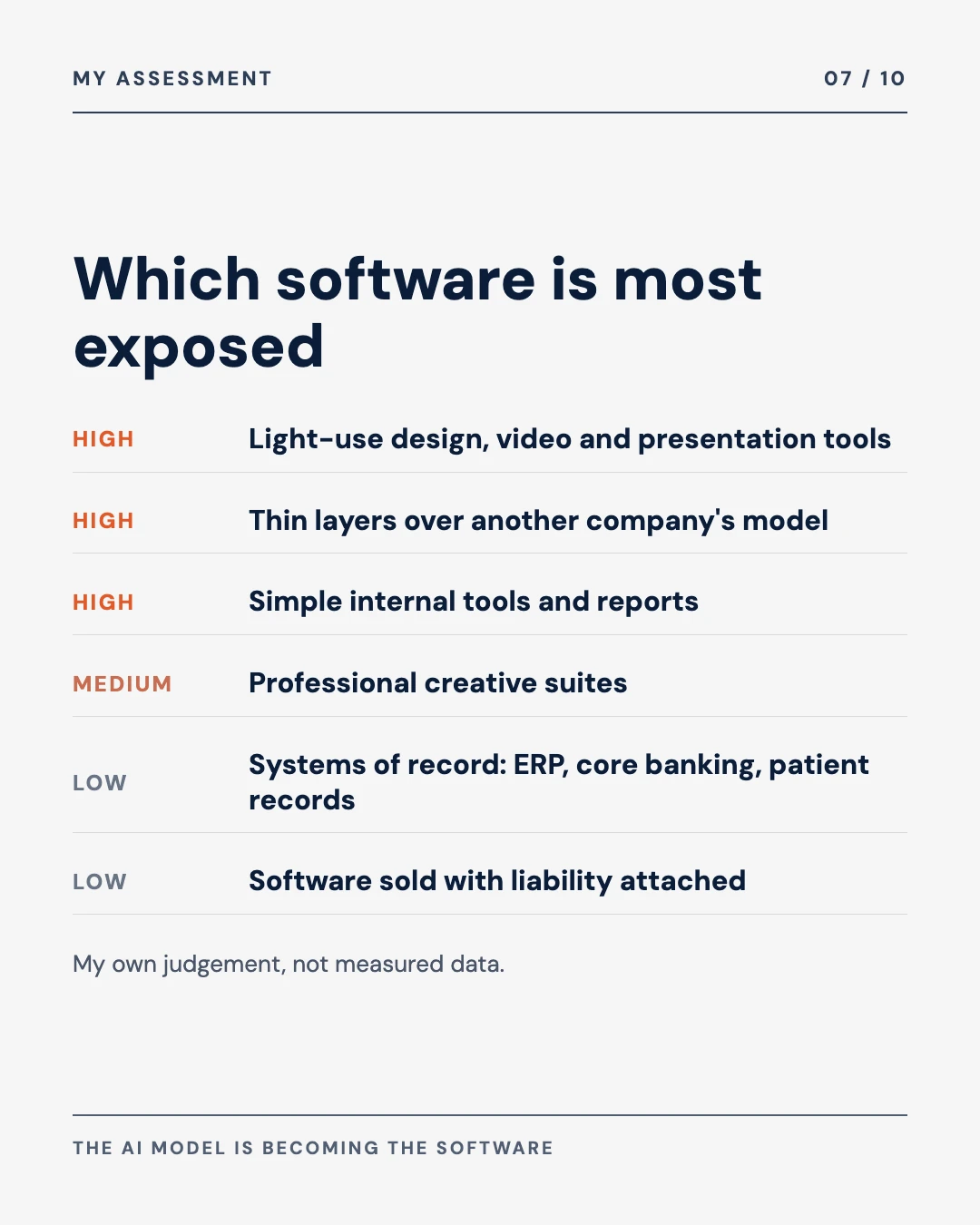
This is my own assessment, based on the October releases and on what I see in client environments. It is a judgement with no survey data behind it.
| Category | Exposure | Why |
|---|---|---|
| Light-use design, video and presentation tools | High | Most users need a small share of the features, and AI subscriptions already cover that share. |
| Thin layers over another company’s model | High | The model owner can ship the same feature to its own users directly, at no extra cost to them. |
| Simple internal tools and reports | High | Teams can now build these themselves in hours with an AI coding agent. |
| Professional creative suites | Medium | Depth and precision still matter to specialists, but the occasional users who make up much of the revenue can leave. |
| Systems of record such as ERP, core banking and patient records | Low | Their value lies in the data, the integrations, the audit trail and the regulatory approval, which a model cannot reproduce on request. |
| Software sold with liability attached | Low | Customers pay for a vendor who stands behind the result, and that remains hard to replace. |
Exposure ratings are my own judgement, not measured data.
The thin layers deserve particular attention. Many products launched in the last three years buy access to a large model, add a user interface and resell the result in bundles of AI credits. When the model owner adds the same capability to its own product, the layer has little left to sell. If your organisation has bought several of these, some of those vendors may not exist in two years. That makes vendor viability a real third-party risk to review.
Free tool
Build vs. Buy vs. Partner
Work through whether a capability should be bought, built in-house or delivered with a partner, before the next renewal comes round.
What dedicated software still does well
The video predicts that by 2027 dedicated tools will be used mainly by a small group of specialists. For creative and office software, that seems plausible. For enterprise software as a whole, I think it overstates the case.
Much of what large organisations pay for has little to do with the interface. They pay for the record of who changed what and when. They pay for permissions that match the organisation chart, for data that stays in an approved region, for a vendor who signs a contract and accepts liability, and for a product that behaves the same way tomorrow as it did today. A model that builds a fresh interface for every request does none of that by default.
There is also the question of consistency. A finance team that closes the books every month needs the same report, built the same way, every time. A model that produces a slightly different tool each time it is asked creates a reconciliation problem. For regulated work, it also creates an audit problem.
The governance cost of software built on demand
This is where I would spend a board’s attention. The more useful the model becomes as software, the more software appears in the organisation that nobody has registered, reviewed or assigned to an owner.
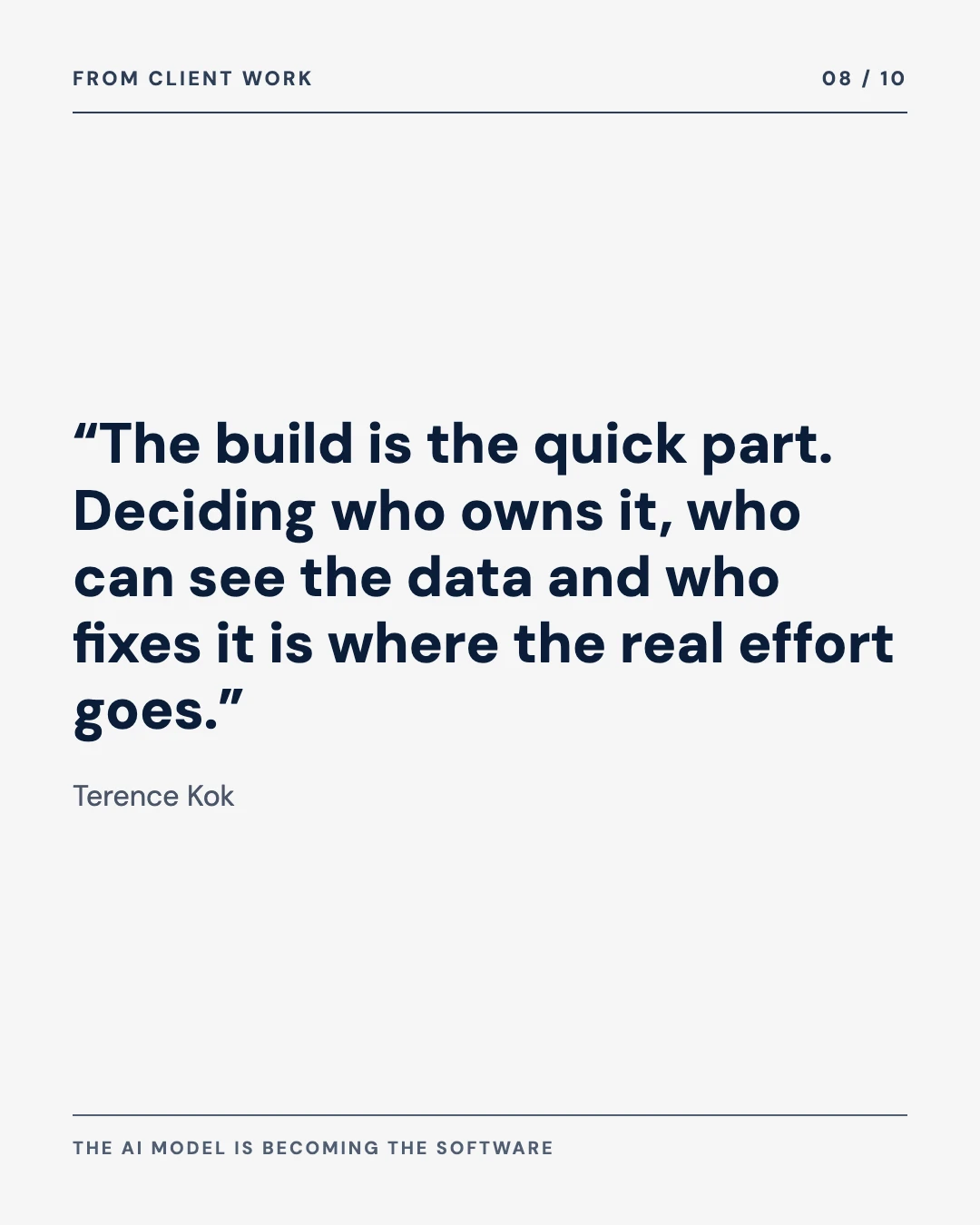
I see the early form of this already. A team builds a small tool with an AI coding agent in an afternoon. It works, colleagues start using it, and within a month it is part of how a process runs. Then the person who built it moves role, the model changes, or the tool produces a wrong figure, and nobody knows how it was built or who is responsible for it.
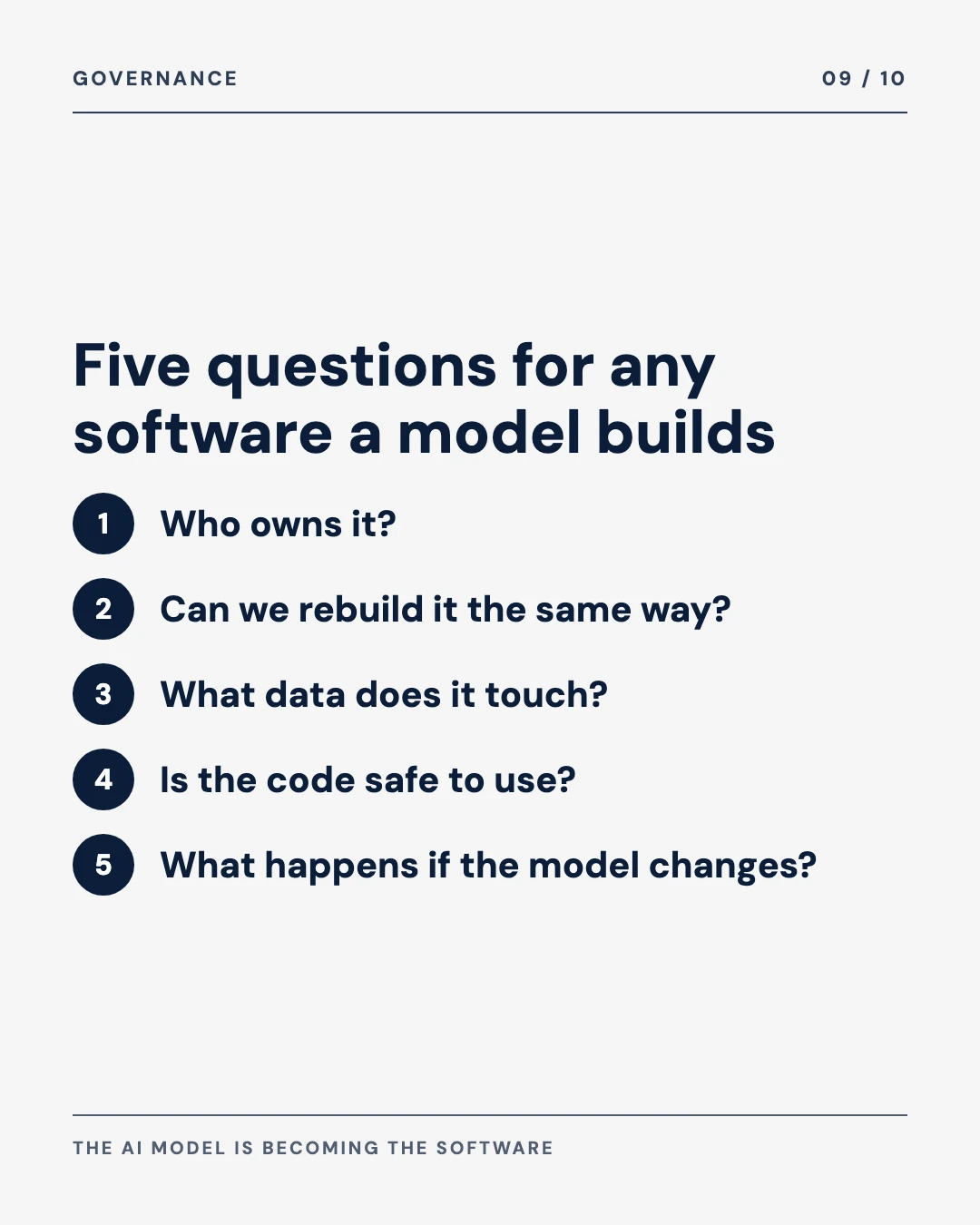
Five questions apply to any software a model builds, whether a person builds it on purpose or the model produces it inside a chat.
| Question | What can go wrong |
|---|---|
| Who owns it? | A tool with no named owner has nobody to fix it when it breaks, and nobody to retire it when it should stop. |
| Can we rebuild it the same way? | If the prompt, the model version and the code are not kept, the next version may behave differently. |
| What data does it touch? | A tool built in a chat can reach customer or financial data without passing through any access review. |
| Is the code safe to use? | Generated code can carry security flaws, and code produced by studying another product can carry legal risk that has not been tested in court. |
| What happens if the model changes? | A provider updating or retiring a model can change the behaviour of every tool that depends on it overnight. |
Questions are my own, drawn from AI governance work with clients.
None of this is a reason to stop people building. The productivity gain is real, and the organisations that learn to use it safely will move faster than those that ban it. It is a reason to treat model-built software as software, with the same register, ownership and change control that any other system gets, scaled down to fit the risk.
There is a security point worth adding. Tools like REA read every piece of text inside the program they analyse, and an AI agent can treat that text as instructions. A program written to mislead the agent could steer it. One commentator on REA recommended running such analysis in an isolated machine with no network access, which is sound advice for any agent working on untrusted files.
What I would do this quarter
Look at your software renewals. For each subscription coming up for renewal, ask how many users rely on its full depth and how many use it lightly. The light users are the ones who may already be covered by the AI subscription you pay for.
Review vendors that resell model access. If a vendor’s main product is an interface over another company’s model, ask what they own that the model provider cannot copy. If the answer is unclear, plan for the possibility that they will not be around.
Register the tools your teams build. Ask each department to list the tools they have built with AI in the last six months. Most organisations I work with are surprised by the length of the list. Assign an owner to each one that touches customer data, money or a regulated process.
Set a rule for model-built software. Something short: if a tool built with AI is used by more than a handful of people, or touches sensitive data, it needs an owner, a stored copy of how it was built and a review before it becomes part of a process.
Evidence & Methodology
The releases and the market figures below come from published reporting. The exposure ratings, the five questions and the actions are my own. Several claims in the video itself did not match the reporting, and I have noted where.
| Claim | Source | Grade |
|---|---|---|
| Worldwide camera shipments fell 94% between 2010 and 2023; compact fixed-lens shipments fell from almost 109 million to 1.7 million | CIPA data, charted by Statista and reported by PetaPixel, August 2024 | Measured |
| One developer released seven open-source Adobe alternatives written with Claude Opus 5.5, in early alpha | Notebookcheck and VICE, October 2026; the video said twelve applications in under two weeks, which I could not confirm | Reported |
| REA lets AI agents inspect compiled applications and build similar features; it does not claim to recover source code or clone apps | REA project README on GitHub | Measured |
| OpenAI announced Pages on 29 September and released Slides on 16 October 2026 | TechCrunch, 29 September 2026; OpenAI release notes via Android Headlines; no Sheets launch confirmed | Reported |
| Anthropic released Claude Motion and Claude Dashboards in beta on 8 October 2026 | Secondary coverage including Unite.AI; I did not locate Anthropic’s own post | Reported |
| Thomson Reuters fell nearly 18% on 3 February 2026 after Anthropic released Claude Cowork plug-ins; RELX fell 14% | Reuters, 3 February 2026 | Measured |
| Light-use software and thin model layers are most exposed; systems of record are least exposed | My own assessment | My call |
| Model-built software spreads in organisations without owners or review | My own observation in client work, not a survey | My call |
Sources
- McClain, C. (2026). Claude Just DESTROYED the Reason You Pay for Software [Video]. YouTube.
- PetaPixel. (2024, August 22). The rise and crash of the camera industry in one chart.
- Notebookcheck. (2026, October 8). Photoshop, Premiere and more: Experienced Rust developer recreates Adobe suite with AI assistance as open source.
- Prada, L. (2026, October 9). Everything we know about the free Adobe clones built with AI. VICE.
- morluto. (2026). REA: Reverse Engineer Anything. GitHub.
- TechCrunch. (2026, September 29). OpenAI takes on Microsoft with the launch of what feels a whole lot like ChatGPT’s own office suite.
- Android Headlines. (2026, October). OpenAI drops ChatGPT Slides to turn conversations into presentation decks.
- Unite.AI. (2026, October). Anthropic launches Claude Dashboards and Motion, takes Docs out of beta.
- Oguh, C., Indyk, S., & Masoni, D. (2026, February 3). Anthropic’s new AI tools deepen selloff in data analytics and software stocks, investors say. Reuters.

Why the AI Model Is the Weakest Link in Your Supply Chain
What happens to every tool built on a model when the provider updates or retires it.

What Your AI Vendor Contract Is Probably Missing
The clauses to check when the vendor is reselling someone else's model.
AI Companies Actually Printing Revenue in 2026
Which parts of the AI market are earning real revenue, and which are not.
If you want a clear view of the AI-built tools already running in your organisation, and the controls they need, that is the kind of work my AI governance advisory covers.