
Executive Summary
If your first AI project feels shakier than the case study made it sound, the numbers say you are in the majority, not the exception. Most teams underestimate how long the wobble lasts and overestimate how fast the payoff arrives. The way through is not more confidence going in. It is a smaller first step, a team that admits the wobble out loud, and a task boring enough that nobody minds if the first version is rough.
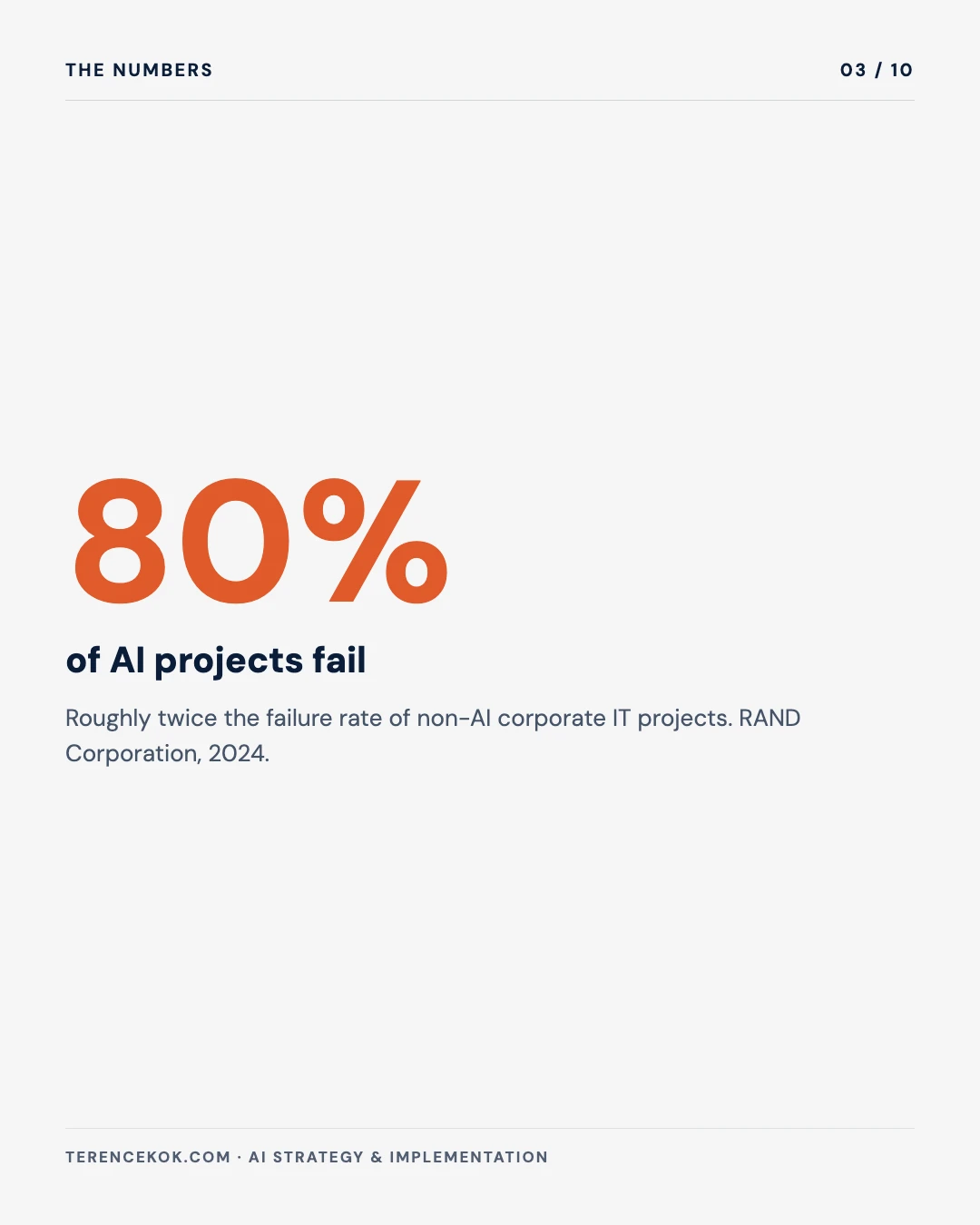
80%
of AI projects fail, roughly twice the failure rate of non-AI corporate IT projects, RAND Corporation, 2024
30%
of generative AI projects were expected to be abandoned after proof of concept by end of 2025, Gartner, 2024
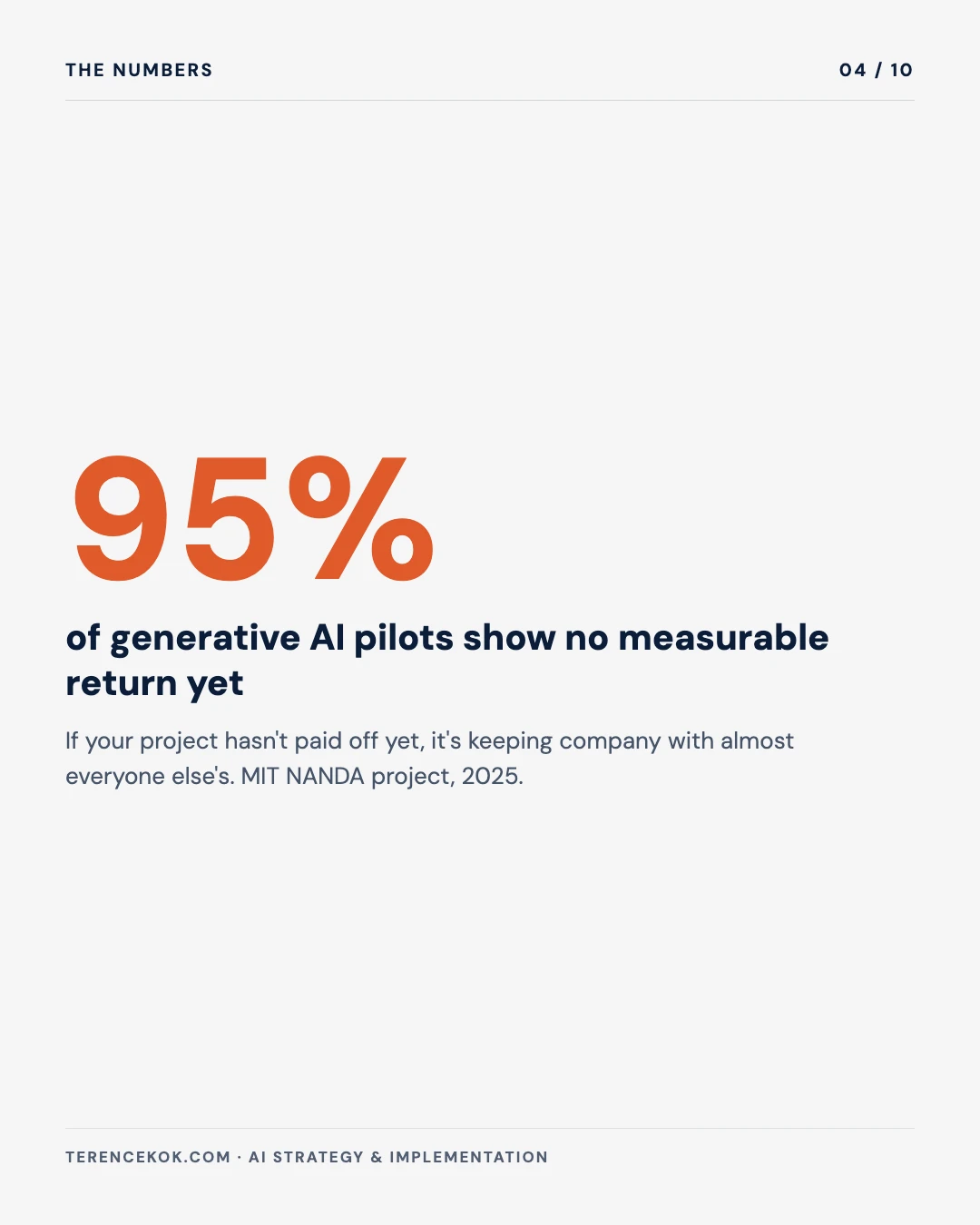
95%
of generative AI pilots were found to show no measurable return yet, MIT NANDA project, 2025
74%
of companies say they are still struggling to achieve and scale value from AI, BCG, 2024
Core conclusions
- The wobble is close to universal, not a sign your team is behind. The failure and stall rates above describe the median AI project, not the unlucky ones.
- Most of the disappointment comes from the height of the goal, not the AI itself. Teams that started with a narrow, boring, repeated task report a steadier first year than teams that started with a transformation.
- A team that names the wobble out loud, learns together, and celebrates the first small win moves faster than one person trying to look confident alone.
Ten slides on the wobble, why it’s normal, and where to start
Save it for the week your own project feels shakier than the slide deck promised.
The wobble you’re feeling right now is close to universal
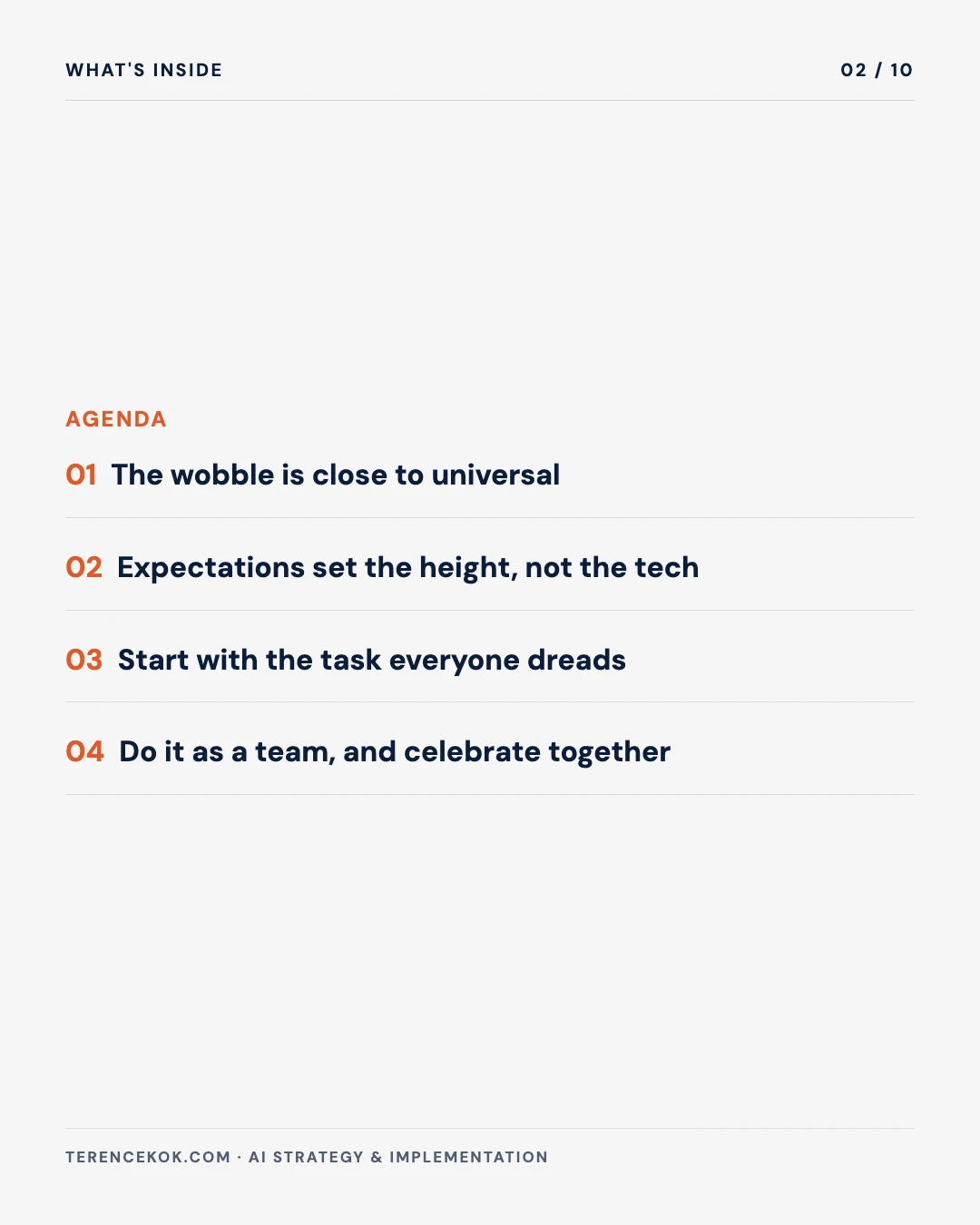
I still remember the exact meeting. Three weeks into our first real AI pilot, the model was doing something none of us had planned for, the client was asking for a demo we weren’t ready to give, and I sat there thinking I must be missing something everyone else already figured out. I wasn’t. I know that now because I have run enough of these since, and watched enough other teams run theirs, to see the same wobble show up almost every time. RAND Corporation put a number on it in 2024: roughly 80% of AI projects fail, about twice the failure rate of ordinary corporate IT projects that don’t touch AI at all. Gartner expected 30% of generative AI initiatives to get abandoned after the proof of concept, before they ever reached production. If you are on the rope right now, arms out, looking for balance, you are not behind. You are in the majority.
I want to say the next part directly, because nobody said it to me early enough: it is okay to feel this way. The unsteadiness is not evidence that you picked the wrong project, hired the wrong people, or misread the technology. It is what implementing something genuinely new feels like, for almost everyone doing it for the first time.
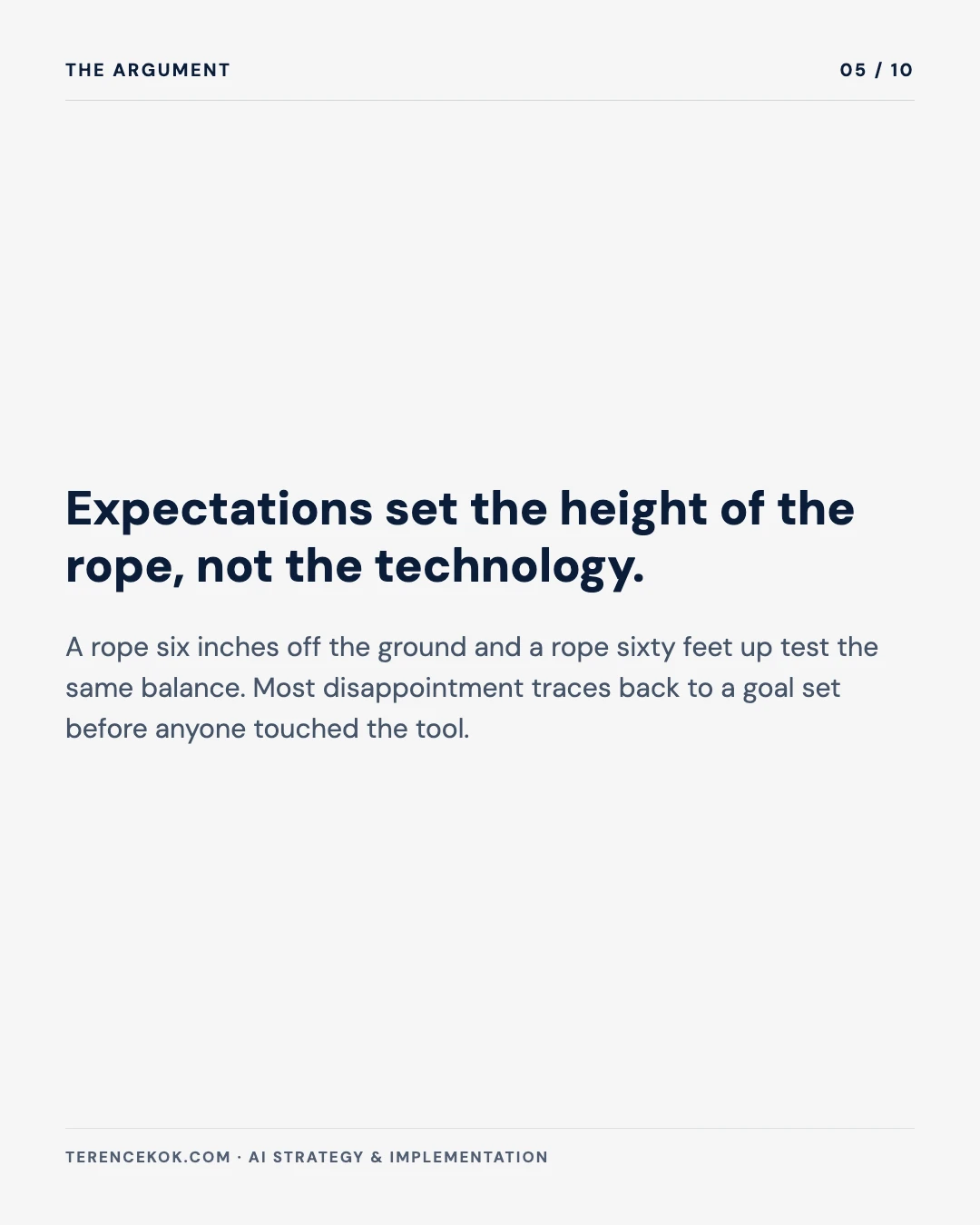
Expectations set the height of the rope, not the technology
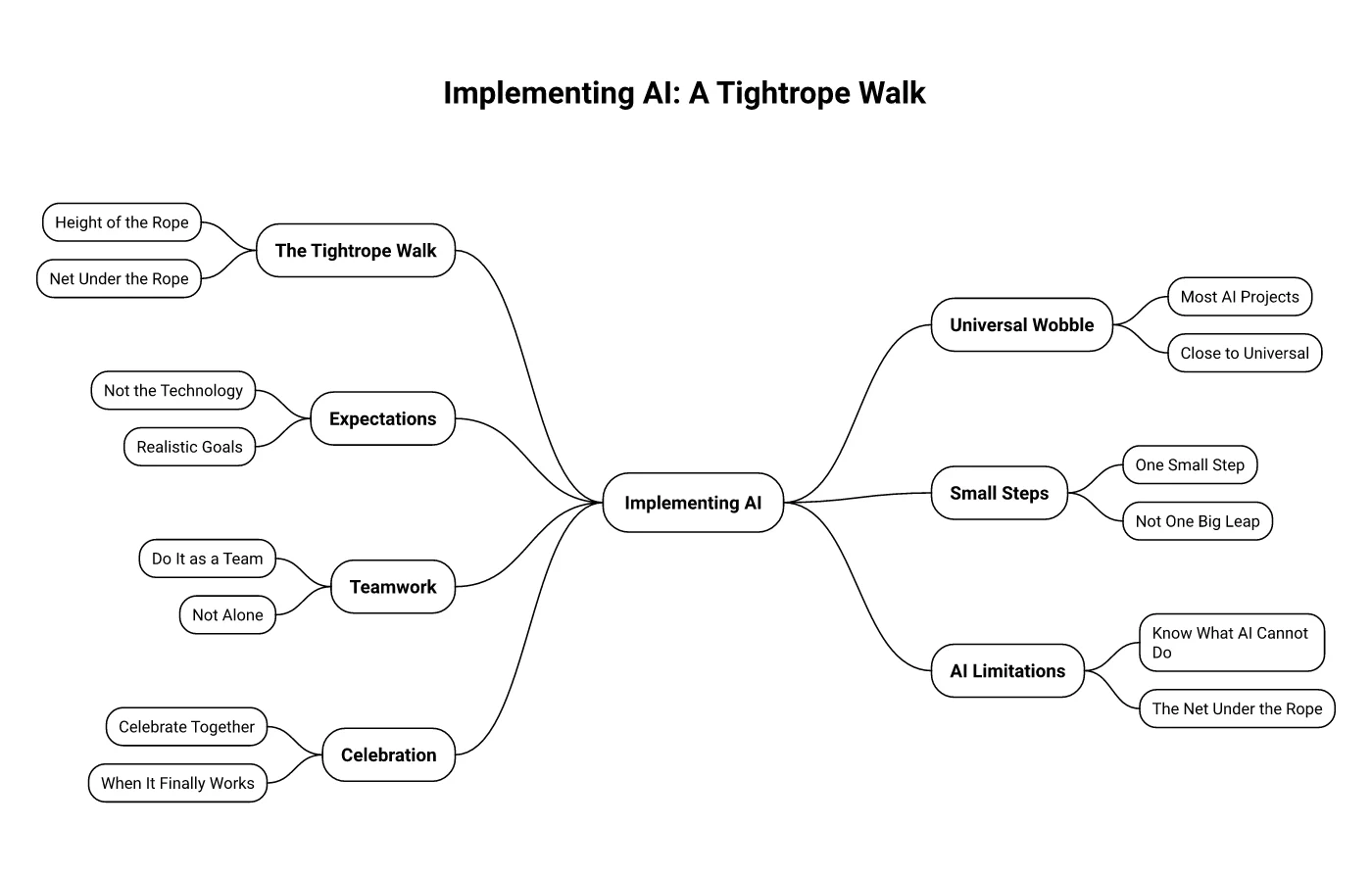
Here is what I think actually separates the wobble that steadies from the one that doesn’t: the height you set before you took your first step. A rope six inches off the ground and a rope sixty feet up test the same balance, but only one of them lets you fall and just get back on. Most of the disappointment I have seen in AI projects, my own included, traces back to a goal set before anyone had touched the tool. We imagined the finished, polished outcome and measured every messy early attempt against it. The technology rarely disappoints as much as the expectation does.
MIT’s NANDA project found that 95% of generative AI pilots studied in 2025 hadn’t yet produced a measurable return, and BCG’s 2024 research put the number of companies still struggling to scale value from AI at 74%. Read those numbers as evidence about timelines, not verdicts on the technology. The gap between a working prototype and something a whole organisation can rely on is real, and it takes longer to close than most kickoff meetings admit out loud.
The first steps bring real discovery, and it’s worth stopping for it
It would be dishonest to write only about the wobble, because the early stretch is also where the actual joy lives. The first time a workflow you automated ran clean end to end without anyone babysitting it, I felt something closer to relief than pride, and then pride caught up a day later. The first time the model surprised us with a genuinely useful edge case nobody had prompted for, half the team crowded around one screen to watch it happen again. Those moments are real, and they are easy to rush past when you are focused on the parts that aren’t working yet. Notice them. They are the reason the wobble is worth going through.
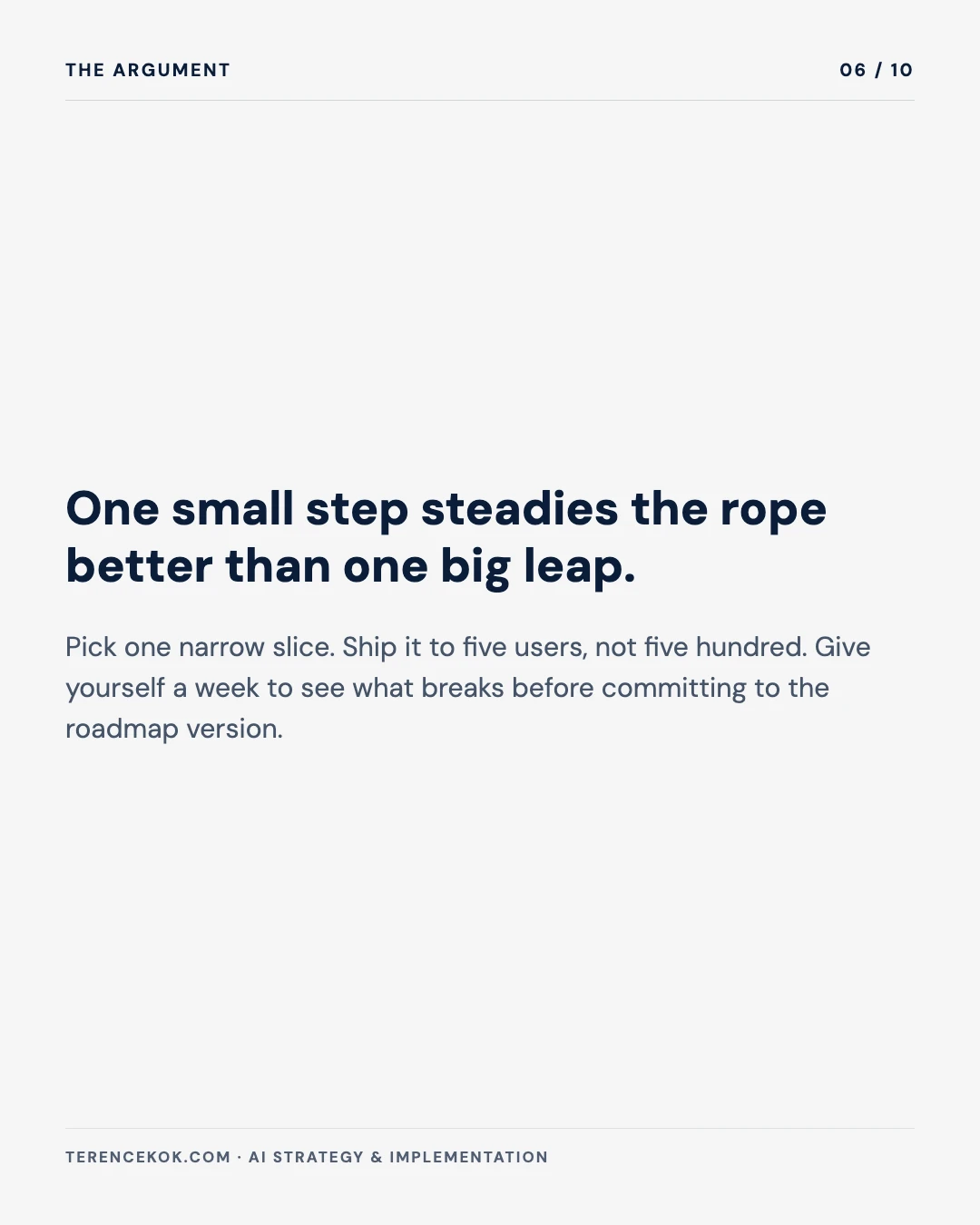
One small step steadies the rope better than one big leap
The teams I have seen recover fastest from a shaky start are the ones who shrank the step they were trying to take, not the ones who tried to build more confidence before taking it. Pick one narrow slice of the problem. Ship it to five users, not five hundred. Give yourself a week to see what actually breaks before you commit to the version you promised in the roadmap. A tightrope walker doesn’t cross in one stride, and neither does a team learning what a model will and won’t do inside their own workflows, with their own data, under their own constraints.
Free tool
AI Use Case Prioritisation Matrix
Score up to three candidate projects across five dimensions and get a ranked order, so the first step you take is the one most likely to hold your weight.
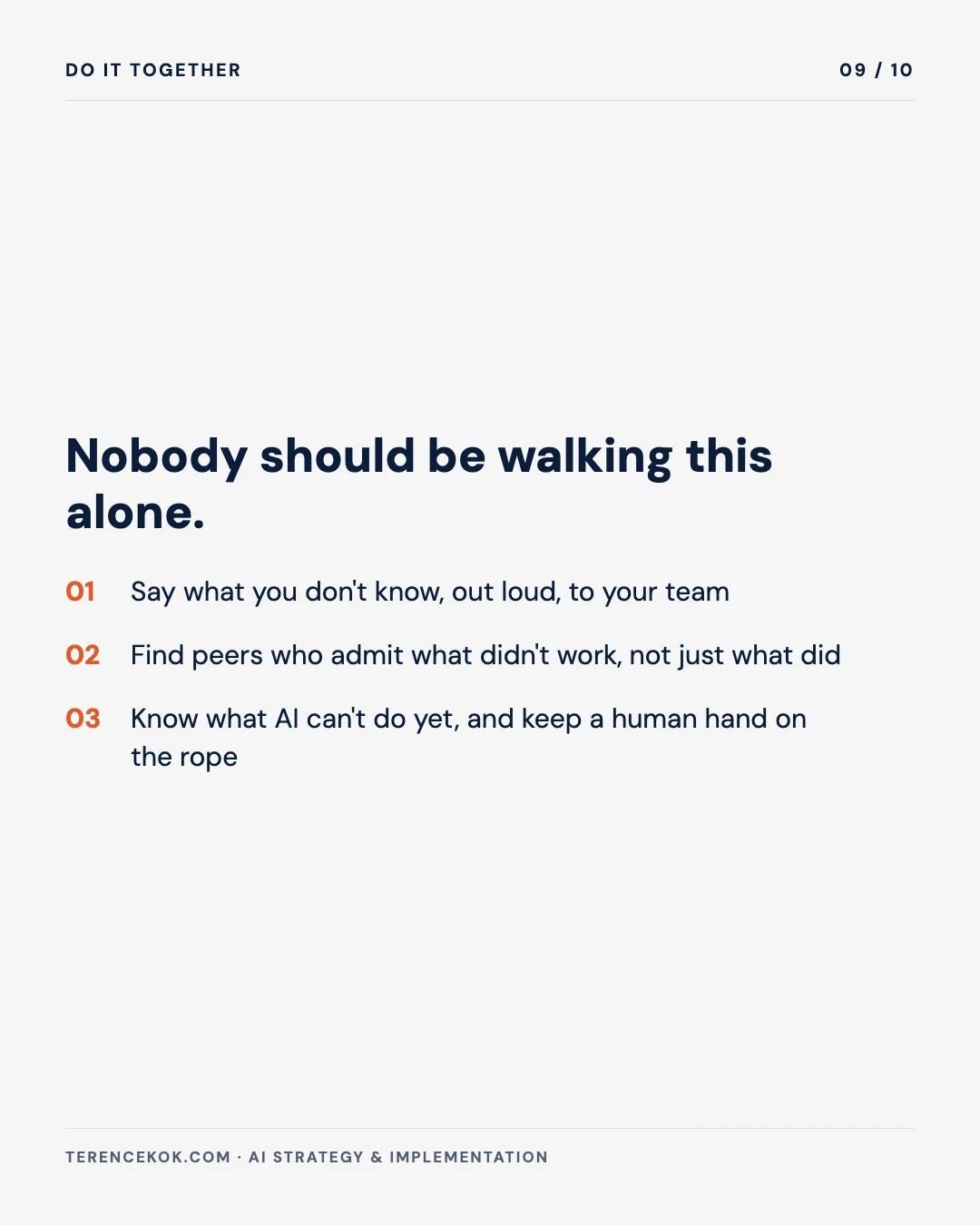
Nobody should be walking this alone
The version of this that nearly broke me the first time was trying to do it solo, or at least trying to look like I was doing it solo while quietly panicking. It gets lighter the moment you stop pretending the wobble isn’t happening and say it out loud to the people next to you. A team that admits together that the first attempt didn’t work moves faster than one person trying to protect their own confidence in front of everyone else. Say what you don’t know. Ask the engineer next to you what she’s seeing that you’re not. The rope holds better with more than one person on it, checking the same footing.
That extends outside your own team too. Find a peer, at another company or another department, who has already fallen off this particular rope and is willing to tell you exactly where. I have learned more from a thirty-minute call with someone who admitted their pilot failed than from most of the polished case studies I’ve read. Look for the people who are open about what didn’t work, not just what did, and stay close to them.
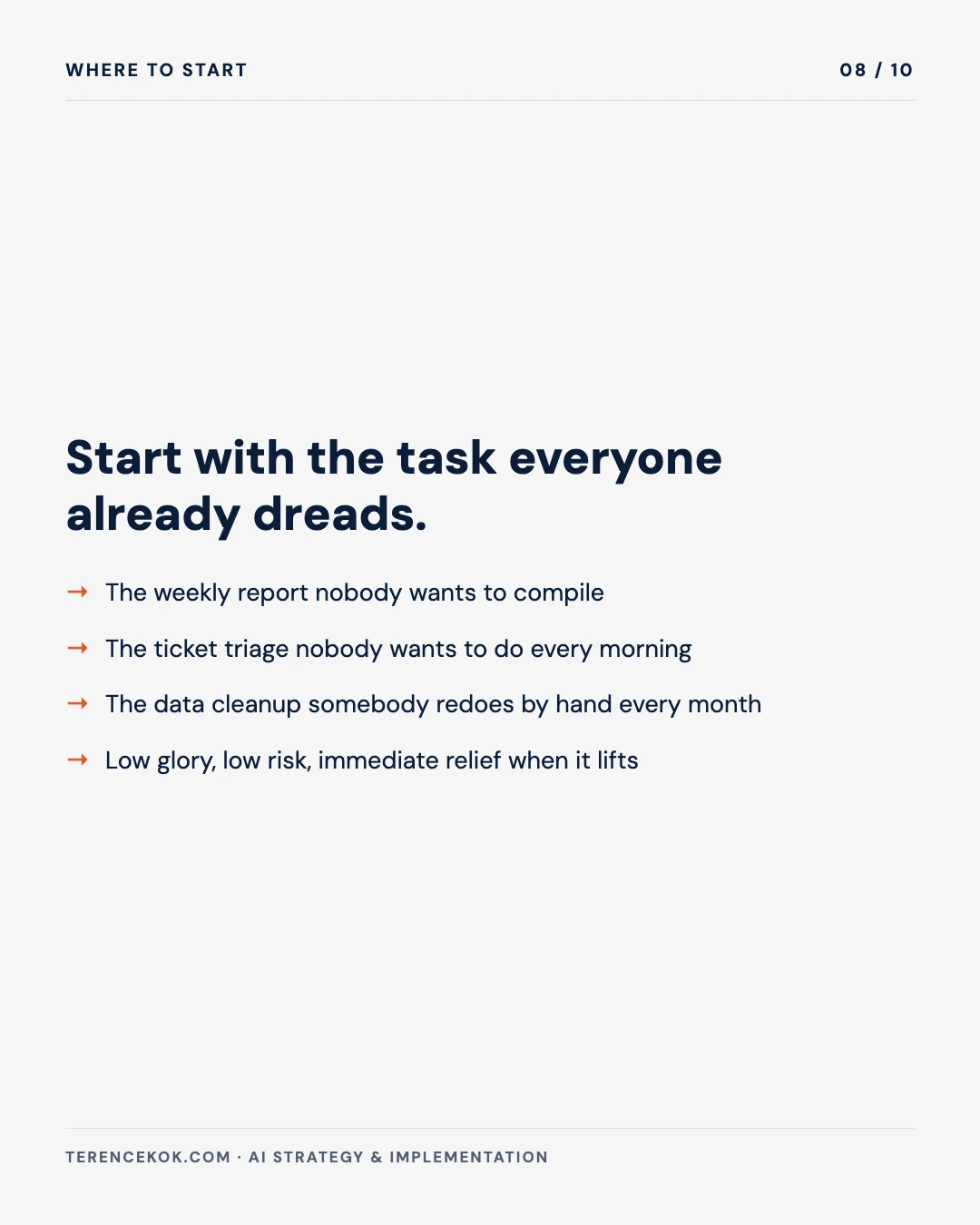
The best first task is the one everyone already dreads
If you’re choosing where to start, choose the task that makes people groan when it lands on their desk, the report nobody wants to compile every week, the ticket triage nobody wants to do every morning, the same data cleanup somebody redoes by hand every month. These repeated, low-glory tasks are the best place to begin, for a simple reason: the bar for success is low and the relief when it lifts is immediate. Nobody is emotionally attached to doing that task themselves. When AI takes even part of it off someone’s plate, the whole team feels it, and that felt relief is what builds the trust you’ll need for the harder, more ambiguous work later.
| What teams expect starting out | What tends to happen instead | Source |
|---|---|---|
| The pilot proves value within the first quarter | Most generative AI pilots show no measurable return yet | MIT NANDA project, 2025 |
| A strong first demo predicts a smooth rollout | About 30% of generative AI projects are abandoned after the proof of concept | Gartner, 2024 |
| Picking the technology is the hard part | 74% of companies say scaling value, not picking the tool, is where they’re stuck | BCG, 2024 |
None of these numbers are a reason to stop. They are a reason to expect the wobble and plan around it instead of being surprised by it.
Knowing what AI cannot do yet is the net under the rope
Part of what steadies the walk is knowing the limits of the thing you’re standing on. AI is genuinely good at pattern-matching across data you already have, drafting a first version of something so you’re editing rather than starting blank, and doing a repeated task at a pace no person can match. It is not good yet at holding judgment for a decision nobody has made before, catching context a human would have caught instinctively, or being accountable when something goes wrong. Knowing where that line sits doesn’t shrink what AI can do for you. It tells you where to keep a human hand on the rope, so a wobble in the part AI is handling doesn’t become a fall.
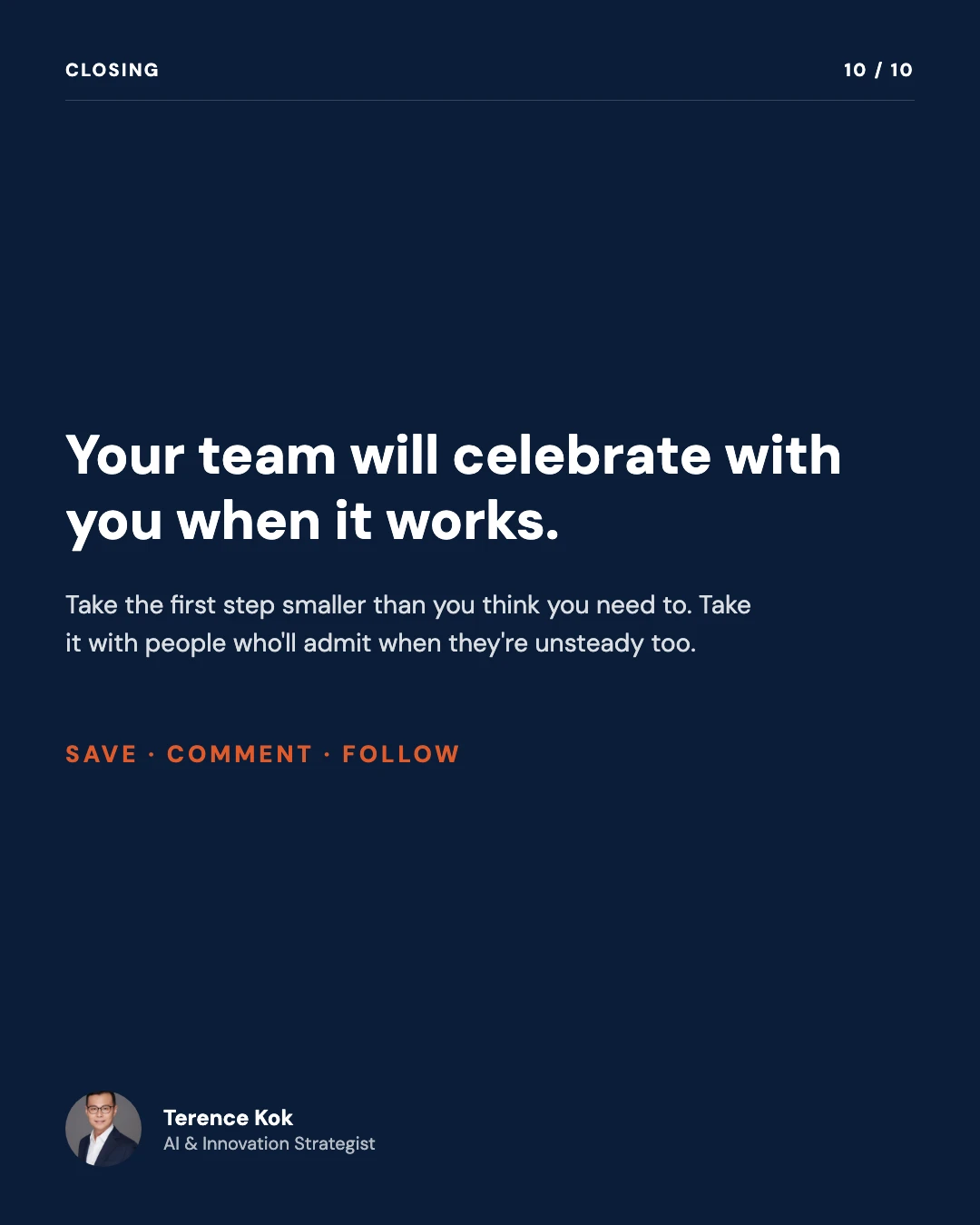
Your team will celebrate with you when it works
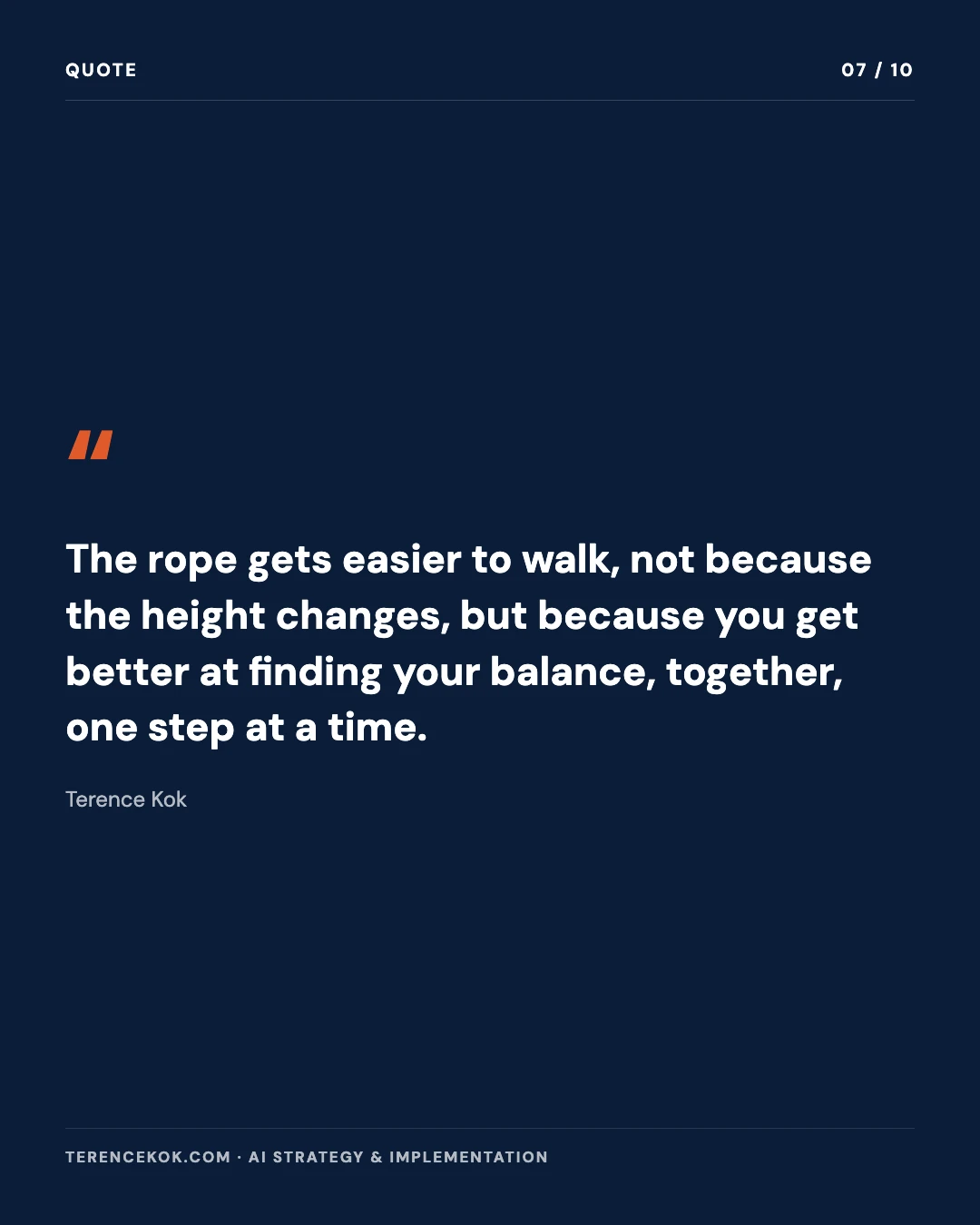
I want to end on the part that made all of this worth it for me: the day the pilot finally worked, cleanly, the way we’d hoped it would three months earlier, the room actually cheered. Not because the project was finished. It wasn’t. But because everyone in that room had felt the same wobble together, and they got to feel the balance return together too. That’s the part nobody puts in the case study. Take the first step smaller than you think you need to. Take it with people who’ll admit when they’re unsteady too. The rope gets easier to walk, not because the height changes, but because you get better at finding your balance, together, one step at a time.
Sources
- RAND Corporation. (2024). The Root Causes of Failure for Artificial Intelligence Projects and How They Can Succeed.
- Gartner. (2024, July 29). Gartner Predicts 30% of Generative AI Projects Will Be Abandoned After Proof of Concept by End of 2025.
- MIT NANDA Project. (2025). The GenAI Divide: State of AI in Business 2025.
- Boston Consulting Group. (2024, October 24). AI Adoption in 2024: 74% of Companies Struggle to Achieve and Scale Value.
If you’re picking the first project to steady yourself on, the AI Use Case Prioritisation Matrix is built for exactly that moment, and the AI Governance & ROI Executive Programme is where I work through the rest of the walk with teams directly.