
Executive Summary
Enterprises across law and banking are converging on the same three-part shape without naming it as a single decision: hybrid squads that blend legal, risk and technical skill; an accountability model where AI triages and a named human still signs; and a workforce strategy that pushes entry-level roles toward advisory work. Each piece is defensible alone. Run together on the timelines enterprises are actually using, they create a specific, measurable failure mode: the training ground that built the judgment those human signatures depend on is being shut down faster than any replacement is being built.
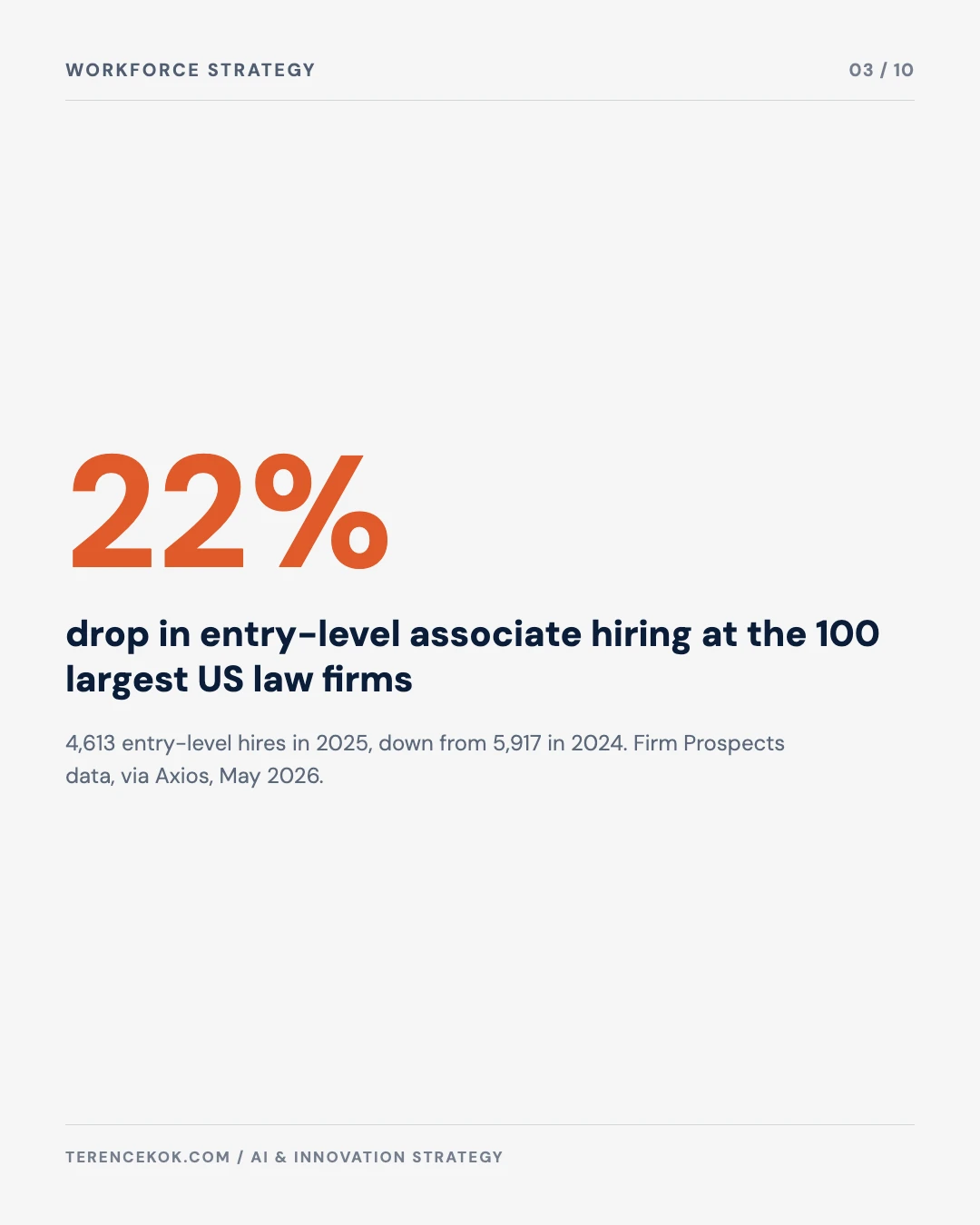
22%
drop in entry-level associate hiring at the 100 largest US law firms, 2025 versus 2024, Firm Prospects data via Axios
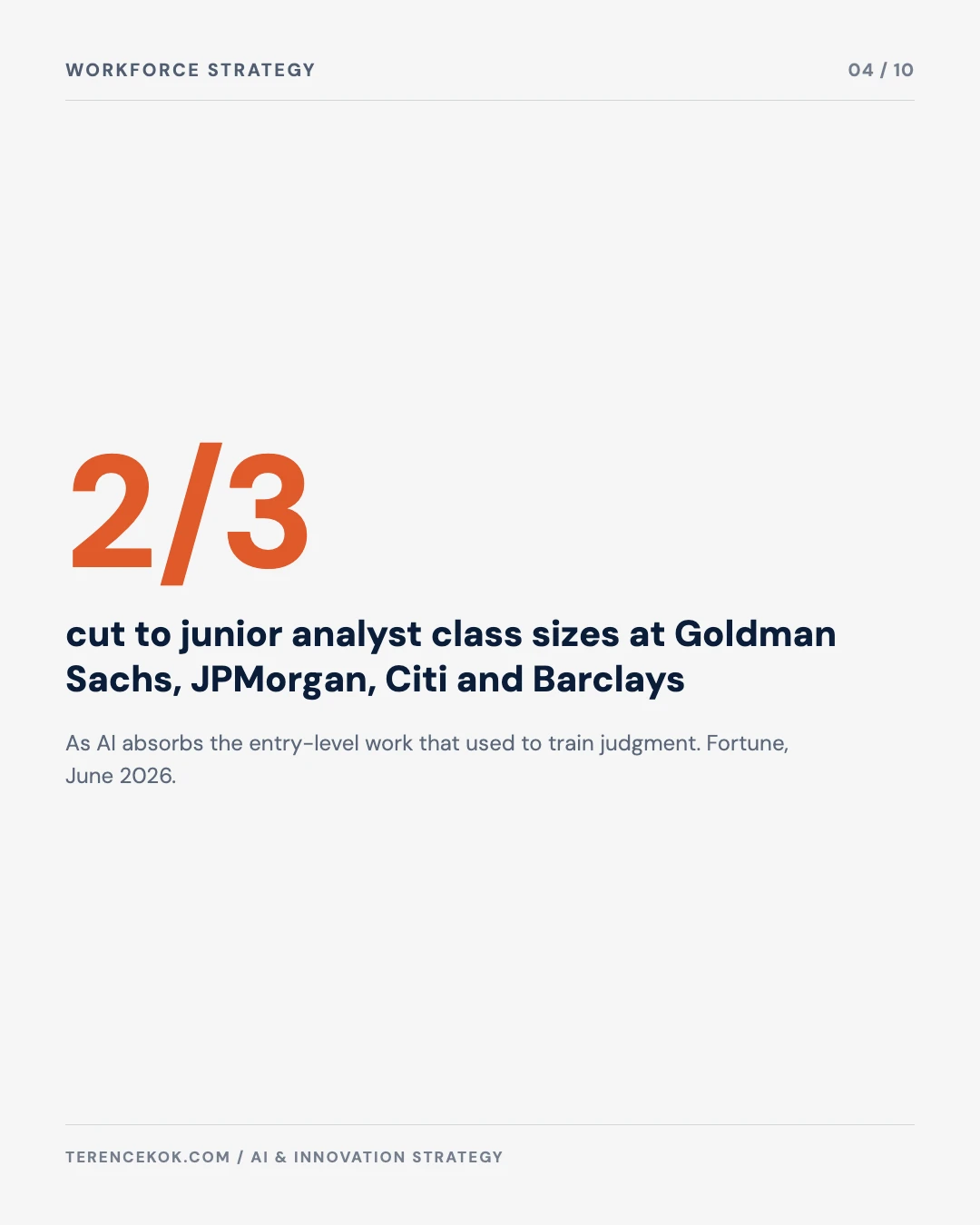
2/3
reduction in junior analyst class sizes at Goldman Sachs, JPMorgan, Citi and Barclays as AI absorbs entry-level banking work, Fortune, June 2026
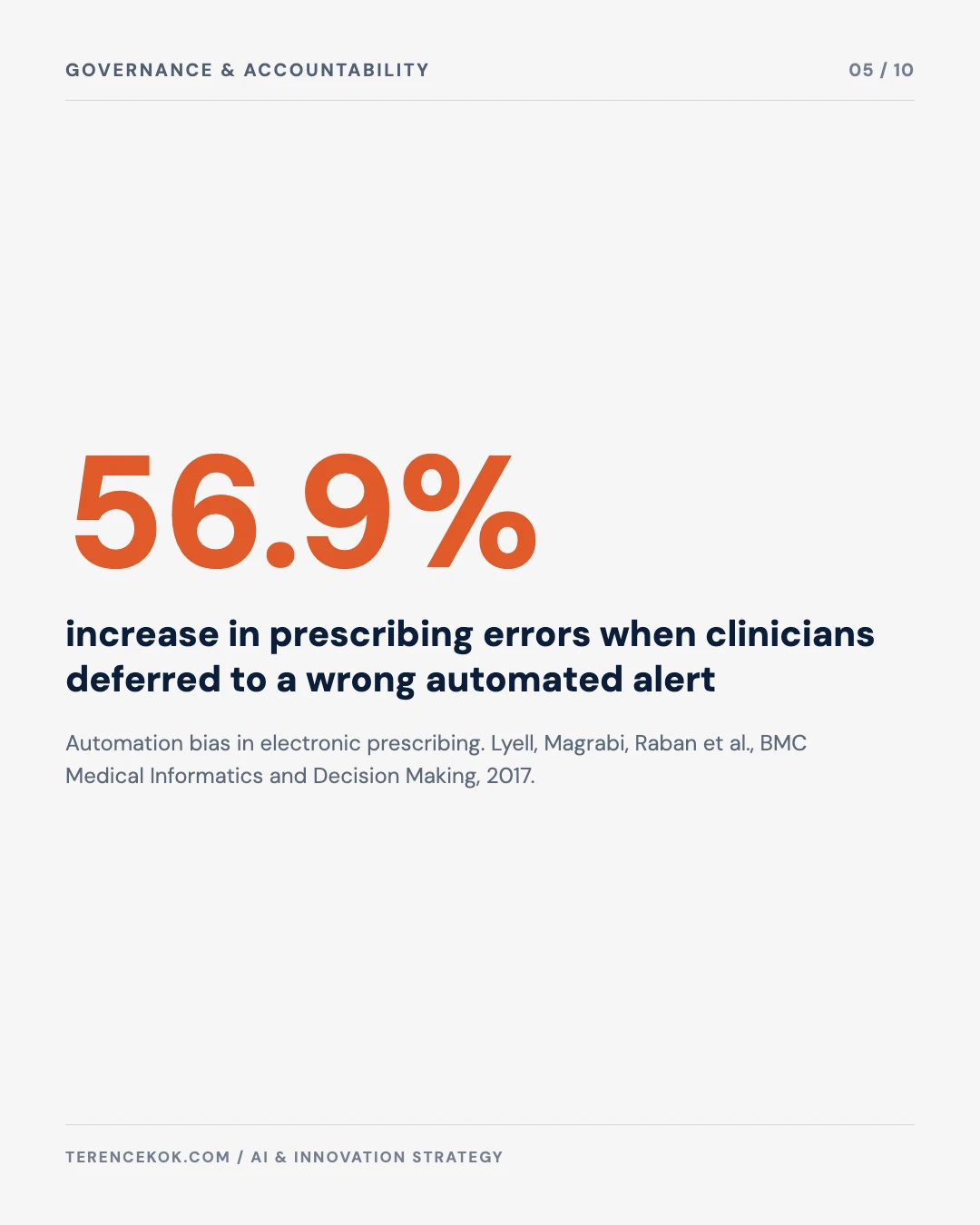
56.9%
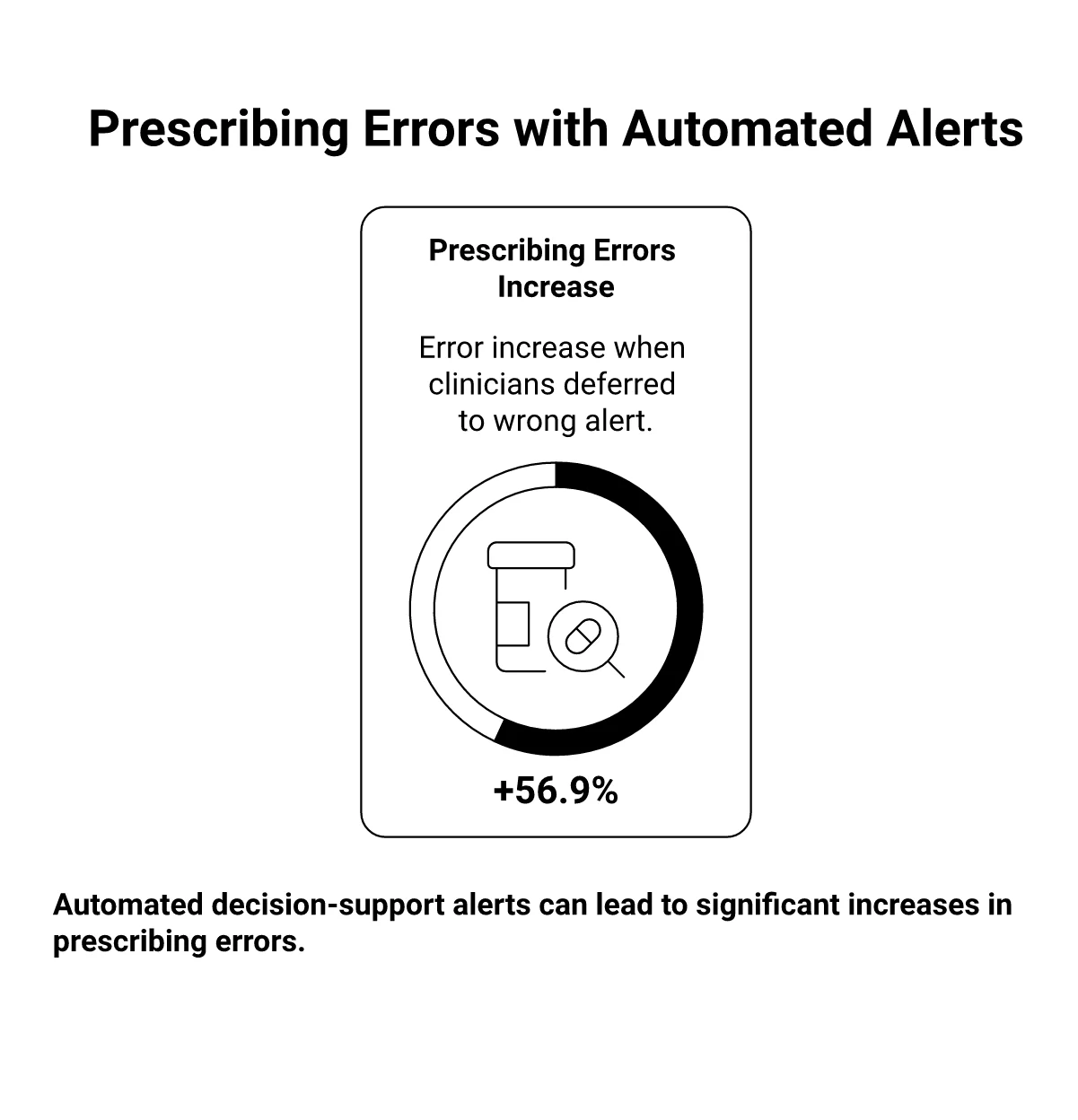
increase in prescribing errors when clinicians deferred to an automated decision-support system that was wrong, Lyell et al., BMC Medical Informatics and Decision Making, 2017
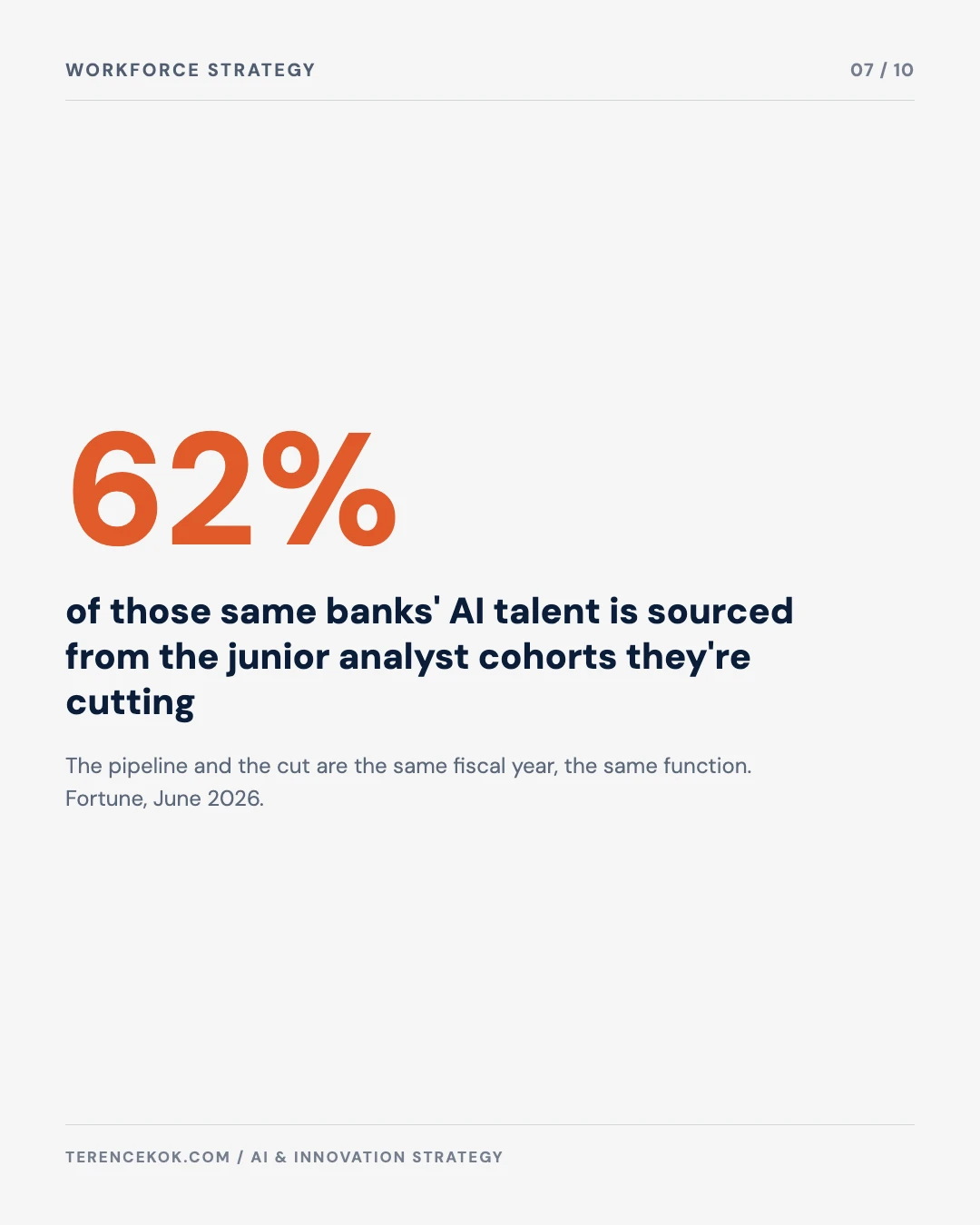
62%
share of those same banks’ AI talent sourced from the junior analyst cohorts they are simultaneously shrinking, Fortune, June 2026
Core conclusions
- The hybrid operating model is already forming under regulatory pressure, mainly the EU AI Act’s Article 14 oversight requirement, and the biggest failure mode isn’t resistance to it, it’s that reskilling always runs slower than deployment.
- ”AI triages, a human decides” only functions as a governance model if that human’s judgment stays sharp. Automation bias research says deferring to a fast, confident system does the opposite, and it does it to seniors as readily as juniors.
- Cutting the entry-level work that used to build judgment doesn’t remove risk from the system. It moves the risk downstream, to the moment a mid-tier employee has to catch a model’s mistake and no longer has the repetitions to recognise one.
The operating model forming across law and banking, ten slides
Save it, share it, or send it to whoever is building your AI governance model without a workforce plan attached to it.
The cuts are already happening, and they’re not a cost story
In February 2026, Baker McKenzie told staff it was cutting up to a tenth of its global business-services workforce, roughly 600 to 1,000 roles across knowledge management, research, marketing and admin, citing AI adoption as a driver. It was the largest AI-attributed cut the legal industry had seen. Three months earlier, Axios reported that the 100 largest US law firms hired 4,613 entry-level associates in 2025, down 22% from 5,917 the year before, tracking a pullback in summer associate programmes that had already been visible in 2023 and 2024. The stated reason isn’t headcount cost. It’s that firms are extracting the procedural knowledge junior lawyers used to build through repetition, contract review, first-pass research, document comparison, and pushing it into AI workflows and client-facing self-service tools instead.
Banking tells the same story with sharper numbers. Fortune’s reporting from June 2026 put JPMorgan, Goldman Sachs, Citigroup and Barclays on record cutting junior analyst classes by as much as two-thirds. Goldman Sachs President John Waldron described the bank’s entry-level function as a “human assembly line” ripe for automation. Citigroup CEO Jane Fraser told staff some roles “will no longer be required.” JPMorgan’s Jamie Dimon said plainly that AI “will eliminate jobs.” None of that is speculative future framing. It’s what four of the largest banks in the world are doing with their 2026 and 2027 graduate intakes right now.
This is the workforce-strategy dimension of the shift, and it is already live, not a 2030 projection. What’s less discussed is what it’s doing to the other two dimensions underneath it.
Free tool
Human-AI Interaction & Decision Quality Dashboard
Benchmark decision acceptance rates and automation bias for your own industry and decision type, against McKinsey, BCG, Stanford HAI and MIT data.
The operating model forming underneath: hybrid squads
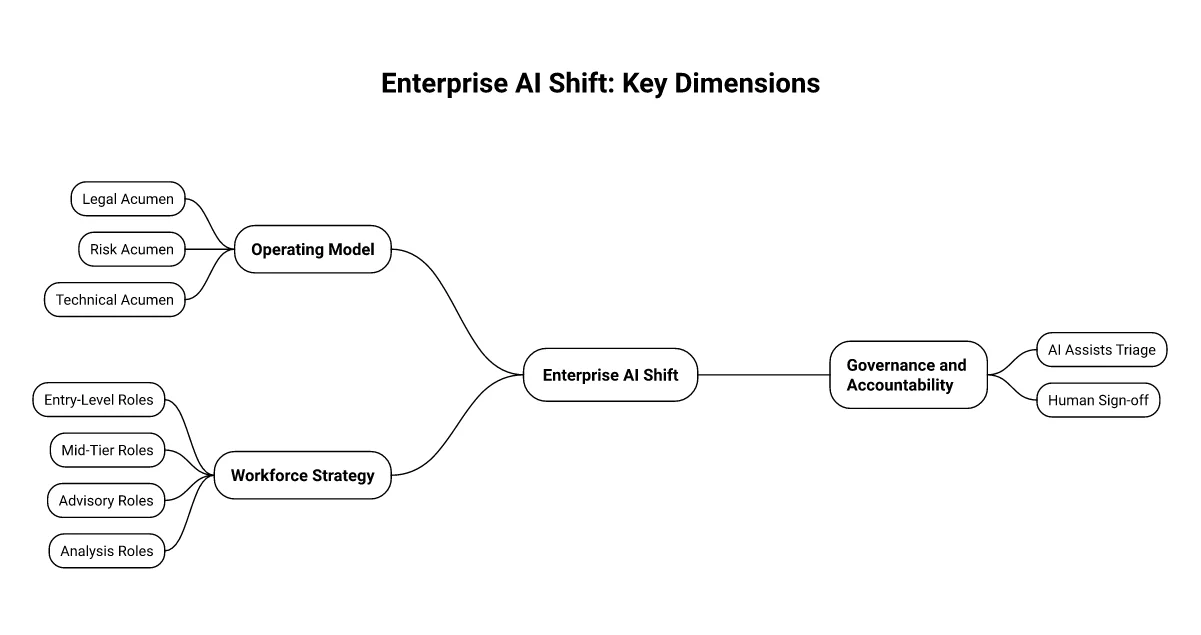
Neither law firms nor banks are simply removing junior headcount and calling it done. What’s replacing the old pyramid is a flatter structure built around hybrid squads: legal, risk and technical skill sitting inside the same working unit rather than handed off between siloed departments. Regulation is a direct driver of this. The EU AI Act’s Article 14 requires demonstrable human oversight for high-risk AI systems, oversight that’s trained, measurable and provable, not a UI approval button bolted onto an automated pipeline after the fact. NIST’s AI Risk Management Framework asks for the same thing in different language. Meeting either requires a legal reviewer who understands the model’s failure modes and a technical reviewer who understands the legal exposure, working together, not in sequence.
The pattern showing up across enterprise AI governance programmes is a federated model: centralised policy and risk appetite set once, execution and ownership distributed to cross-functional committees that typically pull together legal and privacy, IT and security, the business unit that owns the use case, and data science monitoring for drift. That’s the hybrid squad, formalised.
The risk the CSV framework this piece is built on names precisely is skill-mismatch latency. Standing up a hybrid squad on paper takes a policy memo. Building the actual combined fluency, a risk officer who can read a model card, a technical lead who understands regulatory exposure, takes years of deliberate cross-training. Enterprises are deploying the triage systems on product timelines, months, while reskilling programmes run on organisational timelines, years. Cutting the entry-level class that would otherwise supply and season these hybrid squads doesn’t close that gap. It widens it, because the people who’d have grown into that combined fluency through years of procedural reps are the ones no longer being hired.
AI does the triage. Who’s accountable when it’s wrong?
The second dimension is the accountability question, and it looks settled on paper: AI assists, a named human decides, final judgment stays human-led. In practice, that model only holds if the human’s judgment is actually being exercised and not just rubber-stamped. IBM’s governance researchers have a term for what happens when it isn’t: liability laundering, where “a human reviewed it” quietly redirects accountability from the system’s design toward whoever clicked approve, without anyone checking whether that review was substantive.
The evidence that this happens by default, not by exception, is specific. Lyell et al.’s 2017 study of automated decision support in e-prescribing found that when the system erroneously flagged an appropriate drug as inappropriate, and clinicians deferred to it, prescribing errors increased by 56.9%. A 2024 experimental study by Agudo, Liberal, Arrese and Matute, published in Cognitive Research: Principles and Implications, tested the order effect directly: participants who saw an AI’s assessment before forming their own judgment were measurably more likely to adopt the AI’s wrong answer than participants who judged first and saw the AI’s assessment second. The order the triage happens in changes the outcome, independent of anyone’s competence or intent. That’s not a training problem you fix with a memo telling people to “stay critical.” It’s a structural property of how humans process a confident recommendation that arrives first.
Cognitive offloading isn’t a students’ problem. It’s happening to your best people too
The instinct is to treat automation bias and cognitive offloading as a training-pipeline issue, something that only affects juniors who never built the underlying skill. Gerlich’s 2025 study in Societies, based on surveys, critical thinking assessments and interviews with 666 participants across age groups, found a significant negative correlation between frequent generative AI use and critical thinking performance, mediated by cognitive offloading, and that younger, more AI-dependent participants scored lower than older ones. But the effect isn’t age-gated in principle. It’s use-gated.
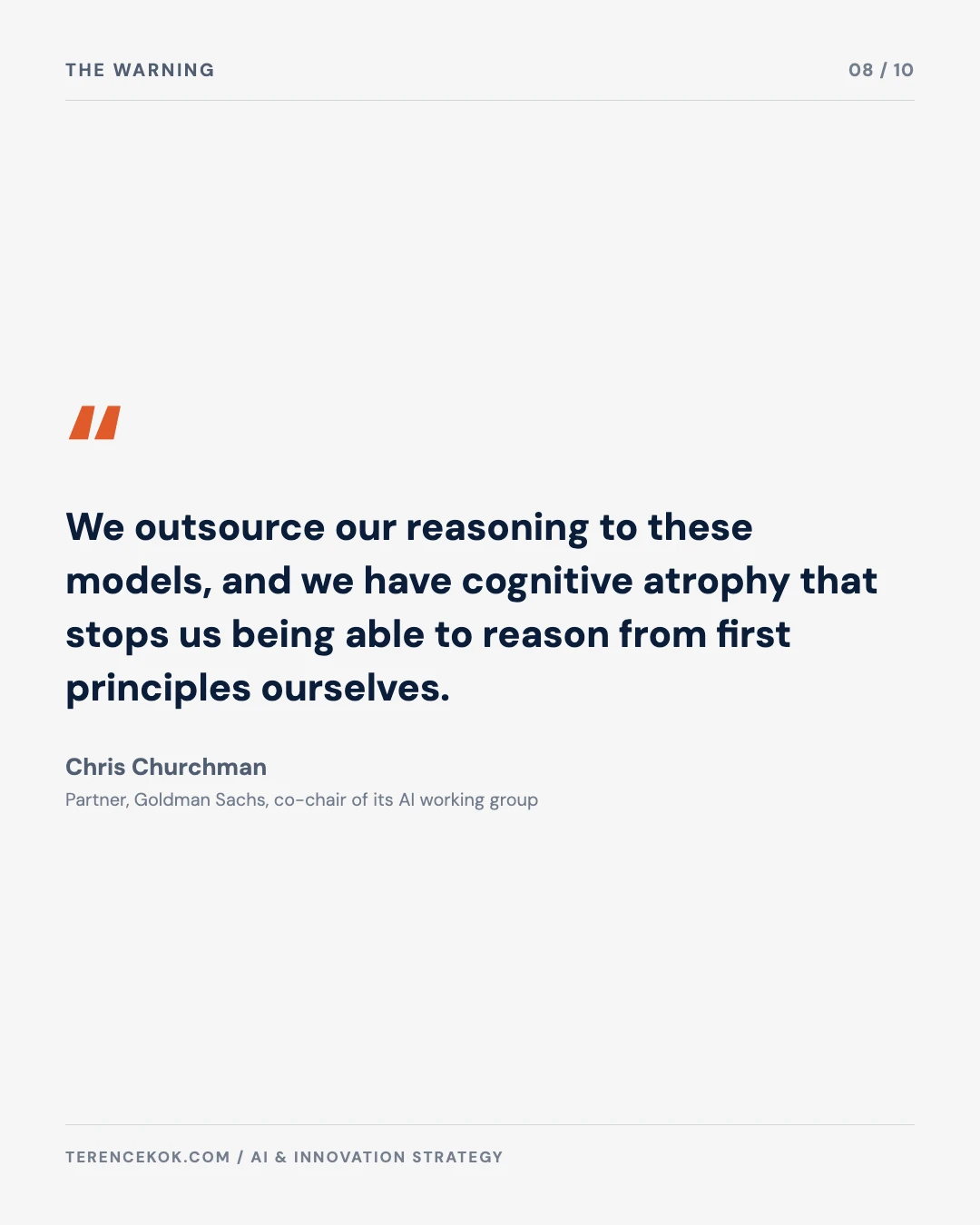
Chris Churchman, the Goldman Sachs partner who co-chairs the bank’s Global Banking and Markets AI working group, made the senior-side version of the same point on the bank’s own podcast in August 2026: “There’s a huge danger here that in the era of AI, we outsource our reasoning to these models, and we have cognitive atrophy that stops us being able to reason from first principles ourselves.” He compared it to what GPS and search engines already did to navigation and recall, skills that quietly atrophied once the tool made the underlying practice optional. His point wasn’t aimed at junior analysts. It was aimed at the entire bank, including the people currently accountable for sign-off.
That’s the connection the three dimensions make when you put them next to each other. The workforce strategy shrinks the pool of people building judgment through procedural reps. The governance model asks a smaller number of more senior people to stay sharp enough to catch a wrong triage call. And the research says staying sharp under those exact conditions, fast, confident, AI-first recommendations, is the hardest version of the task, not the easiest.
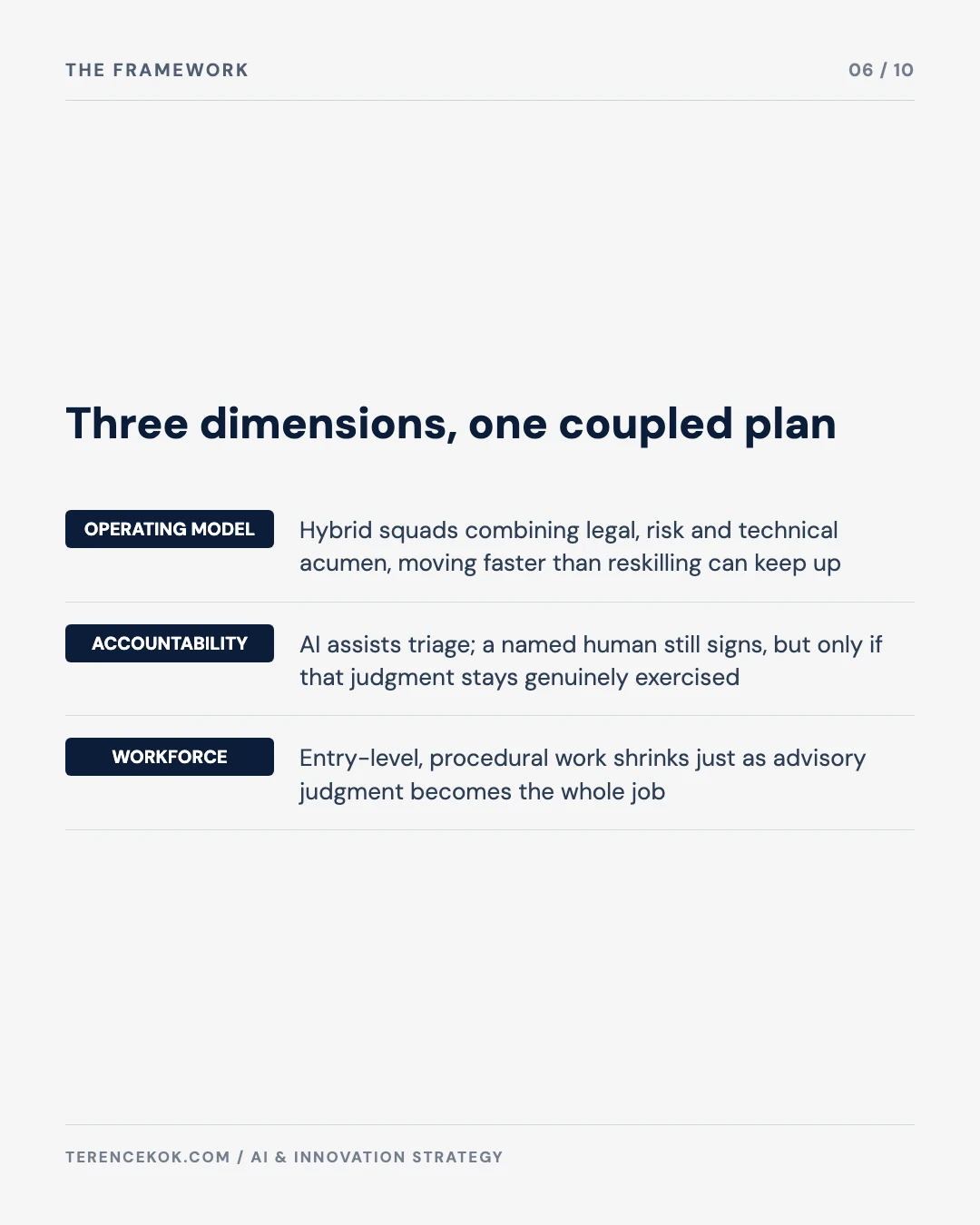
| Dimension | Observation / stance | Operational risk and trade-off |
|---|---|---|
| Operating model | Deployment of hybrid squads combining legal, risk and technical acumen | Skill-mismatch latency during enterprise-wide reskilling: deployment moves on product timelines, reskilling moves on organisational ones |
| Governance and accountability | AI assists triage; final accountability and interpretive judgment remain human-led | Cognitive offloading and over-reliance on automated synthesis without rigorous, structural validation of the review itself |
| Workforce strategy | Shift in entry-level and mid-tier roles toward higher-value advisory and analysis | Requires restructured training pipelines to build judgment without the traditional volume of entry-level procedural tasks |
Each risk in the right column is a direct consequence of the stance next to it, not a separate problem. That’s why they need one plan, not three.
Free tool
Who Actually Owns AI Risk
A straight test for boards and audit committees: is real oversight happening, or is “a human reviewed it” doing the work a governance structure should be doing?
What enterprises should actually do
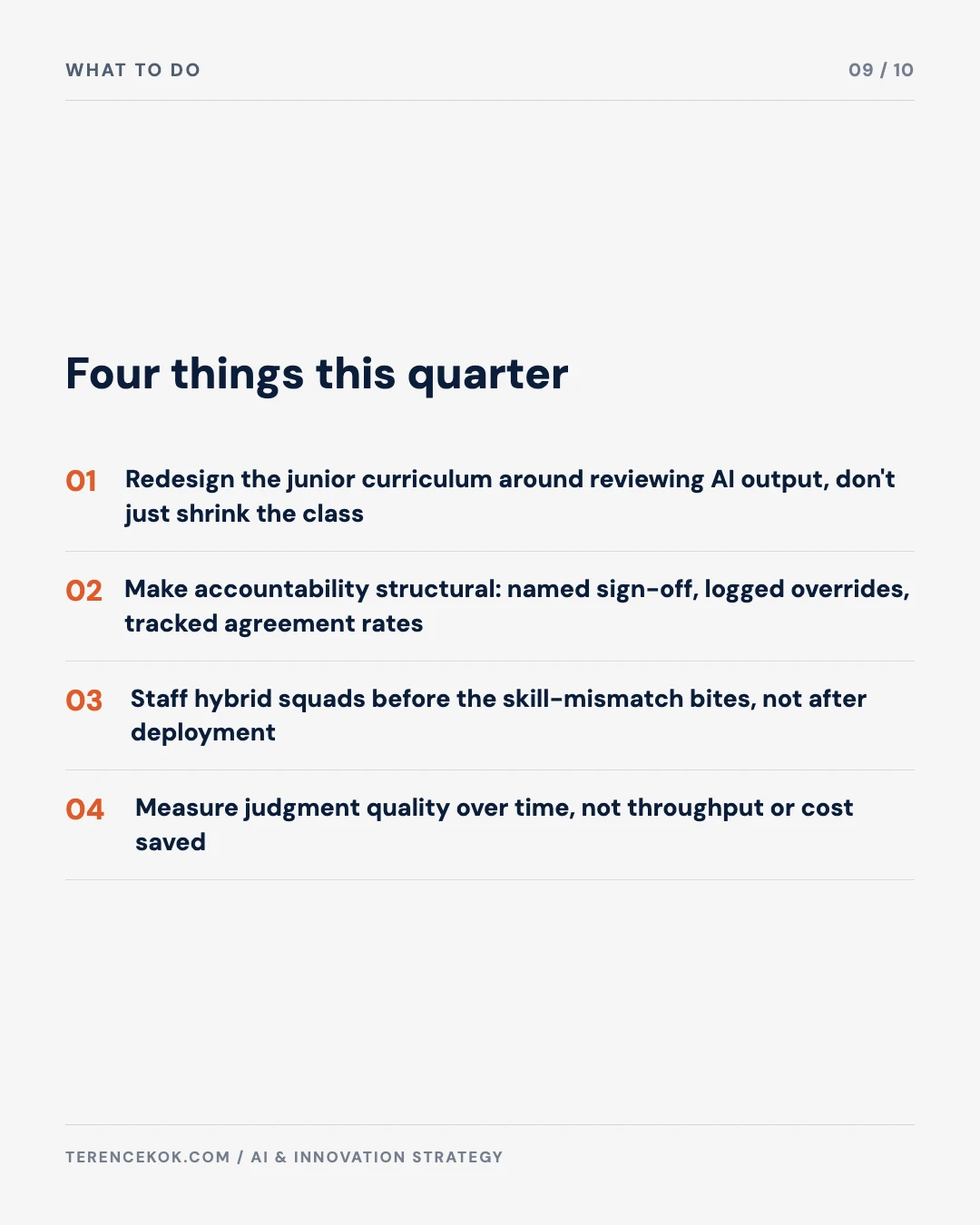
None of this is an argument against AI-assisted triage, and it isn’t an argument for keeping entry-level headcount flat out of caution. Both law and banking have real, defensible reasons to compress procedural work. The argument is narrower: run the three dimensions as one plan, not three separate decisions made by three separate committees on three separate timelines. Four things follow from that.
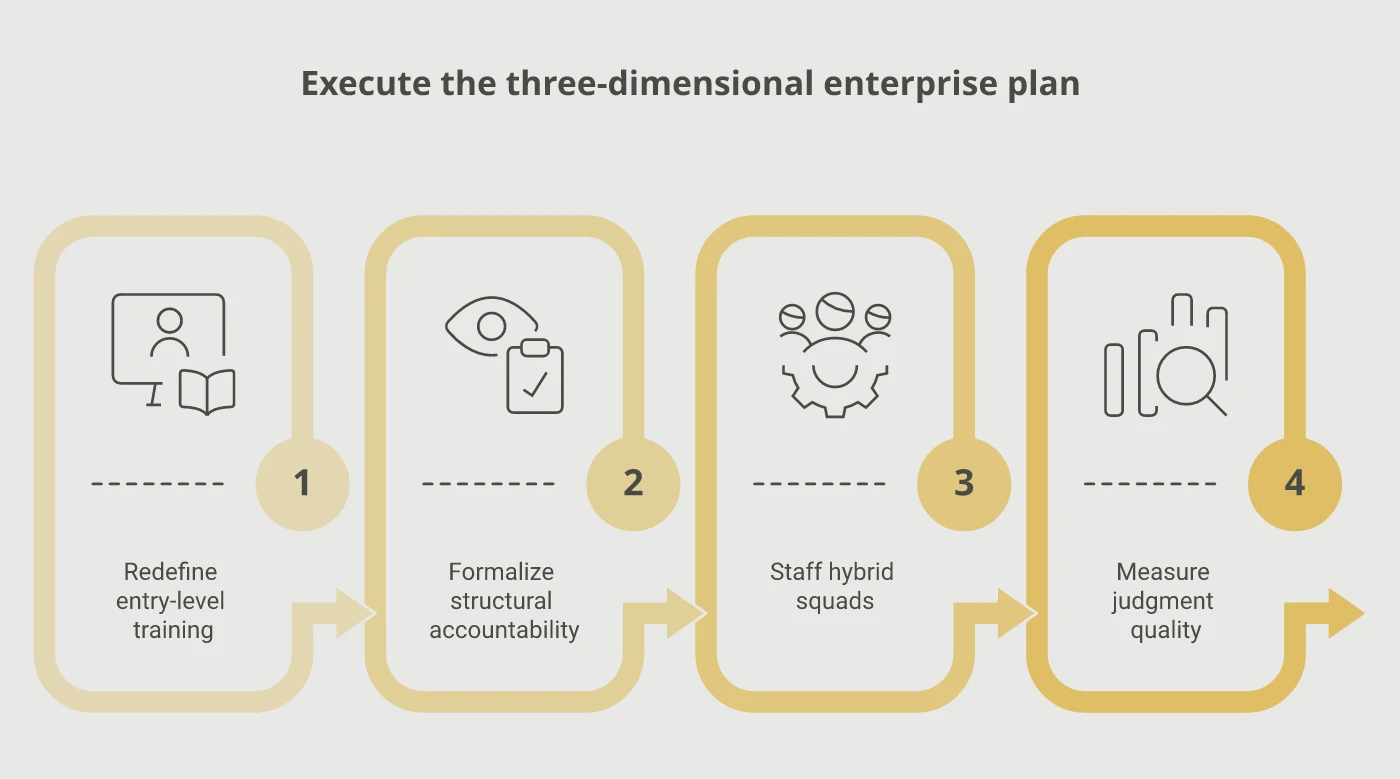
First, treat the entry-level cut as a curriculum problem, not an arithmetic one. If procedural volume is disappearing as a way to build judgment, replace it deliberately, with structured review of AI-generated output as the new training ground, not an assumption that judgment will appear at the mid-tier on its own. Firms cutting summer associate programmes without redesigning what the smaller remaining class actually spends its time doing are solving for cost and creating a training gap at the same time.
Second, make accountability structural rather than decorative. Name, for each decision type the AI triages, exactly who has sign-off authority, log every override with a reason, and track the override rate itself as a leading indicator. If a reviewer is agreeing with the AI at a rate that doesn’t move regardless of the recommendation’s actual quality, that’s the liability-laundering pattern showing up in your own data, not a sign the system is working well.
Third, staff the hybrid squads before the skill-mismatch bites, not after. Put legal, risk and technical people into the same working unit now, and budget for the multi-year training lag explicitly in the deployment plan rather than assuming fluency arrives on the same schedule as the software. A rollout timeline that assumes instant cross-functional competence is the single most common way the operating-model risk in the table above turns from a trade-off into an incident.
Fourth, measure judgment quality over time, not throughput or cost saved. Override accuracy, escalation quality and near-miss catches at the mid-tier are the metrics that tell you whether the accountability model is actually holding. Cost-per-transaction and headcount reduction tell you the opposite thing, how fast you’re spending down the reserve of judgment the old pyramid used to build, without telling you when it runs out.
The banks cutting junior analyst classes by two-thirds while sourcing 62% of their AI talent from those same cohorts are living the contradiction in real time. That’s not proof the strategy is wrong. It’s proof the three dimensions are already coupled whether an enterprise plans for it or not, and the ones that plan for it deliberately will be the ones still able to staff the hybrid squad, trust the sign-off, and answer for the judgment when a regulator, a client or a board asks who actually decided.
Sources
- Axios. (2026, May 2). AI threatens Big Law’s talent pipeline.
- Global Legal Post. (2026, February). Baker McKenzie cites AI as it prepares to cut business services roles.
- Fortune. (2026, June 7). Banks lay groundwork for mass workforce cuts as AI takes hold.
- CNBC. (2026, August 24). Goldman Sachs partner warns of ‘huge danger’ in letting AI replace bankers’ reasoning skills.
- Lyell, D., Magrabi, F., Raban, M.Z., et al. (2017). Automation bias in electronic prescribing. BMC Medical Informatics and Decision Making, 17, 28.
- Agudo, U., Liberal, K.G., Arrese, M., & Matute, H. (2024). The impact of AI errors in a human-in-the-loop process. Cognitive Research: Principles and Implications, 9(1), 1.
- Gerlich, M. (2025). AI Tools in Society: Impacts on Cognitive Offloading and the Future of Critical Thinking. Societies, 15(1), 6.
- IBM Think. (2026). Why ‘human in the loop’ alone is not a governance strategy.
The AI Governance & ROI Executive Programme works through exactly this coupling at the organisational level, mapping accountability structures and hybrid-squad staffing before the reskilling gap becomes an incident instead of a plan. Details are on the workshops page.