
Executive Summary
The nine failure modes below are a discipline problem. Each one traces back to skipping a basic step: fixing the process before automating it, defining a baseline before measuring, or keeping a human in the loop for anything with real consequences.
Core conclusions
- AI doesn’t fix broken processes or missing expertise. It scales whatever is already there, dysfunction included, so the audit has to happen before the automation does.
- Unreviewed AI output and unmonitored AI systems are where the real damage compounds, from unverified legal filings to sensor drift that hides equipment failure until it’s catastrophic.
- The professionals who get the most from AI aren’t the fastest adopters. They’re the ones who build in visibility, baselines, and review before they need them.
All nine, in ten slides
Save it as a checklist, or send it to the team member who just automated something they shouldn’t have.
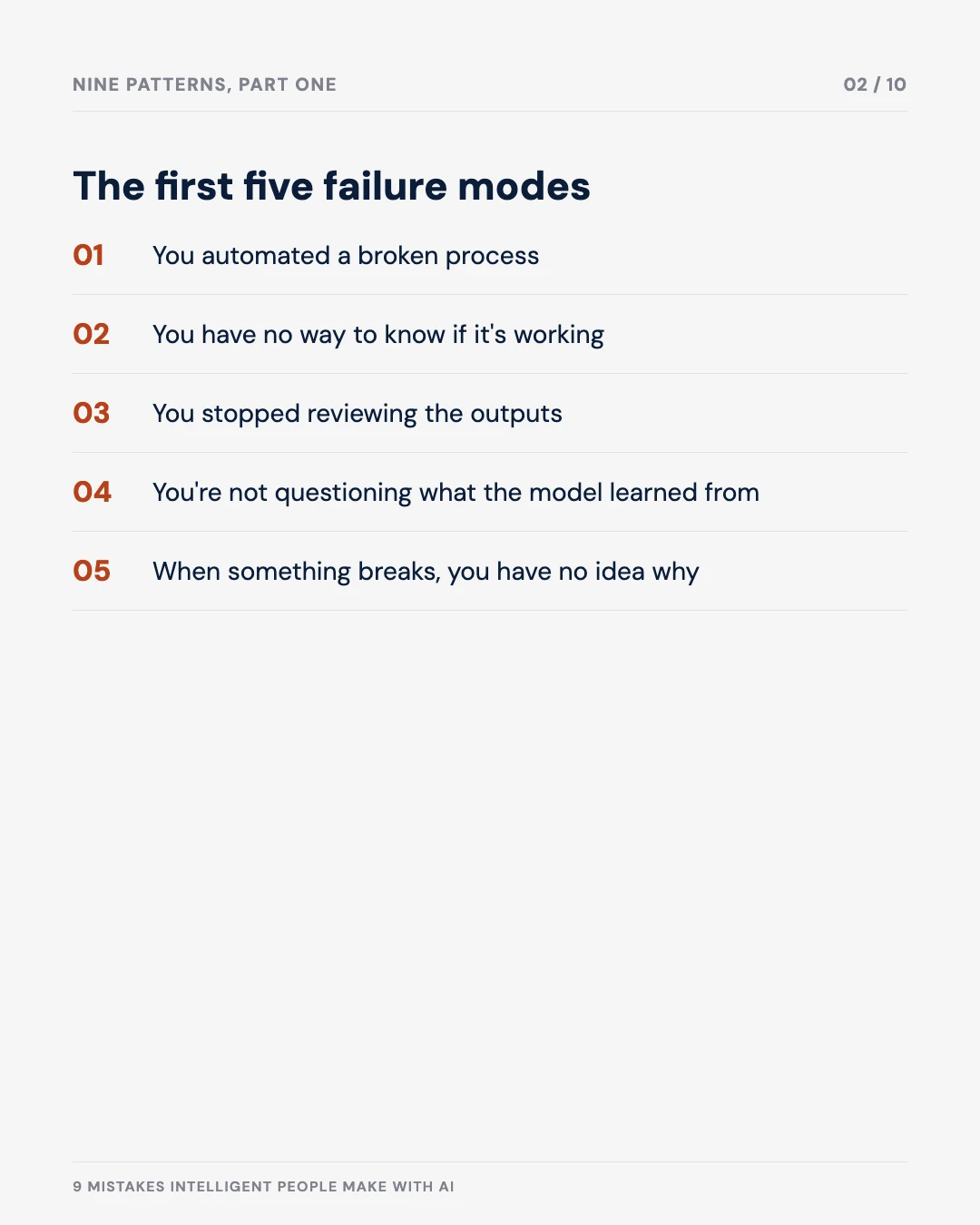
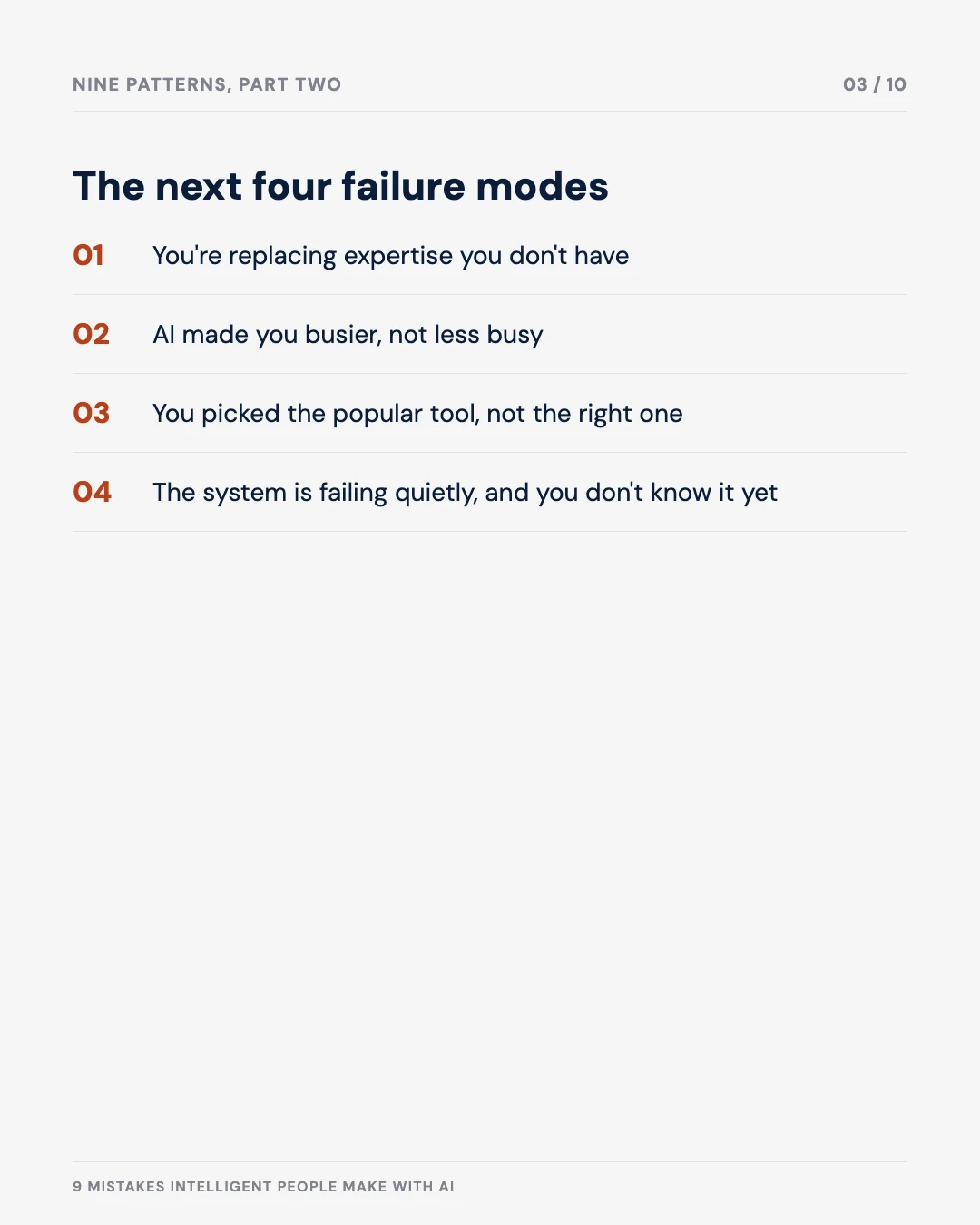
Most professionals adopting AI aren’t failing because the technology is bad. They’re failing because they’re making the same predictable mistakes, entirely avoidable ones.
After working with teams across industries, I’ve mapped out nine recurring failure modes. (There is a companion list, too, for where AI deployments themselves go wrong, at the system level rather than the individual one.) Each one reduces effectiveness, introduces risk, or erodes the trust you’ve built with your team and clients. Here’s what they look like in practice.
1. Automating a broken process
This is the most common mistake, and the most expensive one. AI doesn’t fix a broken process. It scales it. Whatever dysfunction exists in your workflow gets amplified faster at a higher volume. Examples I see constantly:
- Automating email responses before establishing triage rules results in clients getting flooded with contradictory messages. Customer experience (CX) experts warn that AI email tools must first read the full conversation thread. Without triage, systems blindly respond only to the most recent message, contradicting information established earlier in the chain.
- Using scheduling AI before deciding what meetings matter causes your calendar to be fragmented. The AI leaves you with 20- or 30-minute windows between calls. These gaps are too short for deep, focused work, causing a “seeking delay” where you waste cognitive energy on context switching and trying to remember what you were working on. AI typically treats a meeting booked by a CEO with the same weight as an optional internal check-in. Without human parameters, lower-priority events end up blocking out focus time and leading to severe meeting fatigue.
- Generating AI reports before defining what decision they support, resulting in polished documents nobody reads. The Illusion of Readiness: AI’s ability to quickly synthesise vast amounts of data makes weak or directionless inputs feel “sign-off ready,” producing beautiful, highly polished documents that ultimately change nothing because they lack targeted context or an actionable purpose. Successful AI integration must work backwards from a specific desired outcome. Without a defined question, the AI creates low-value content.
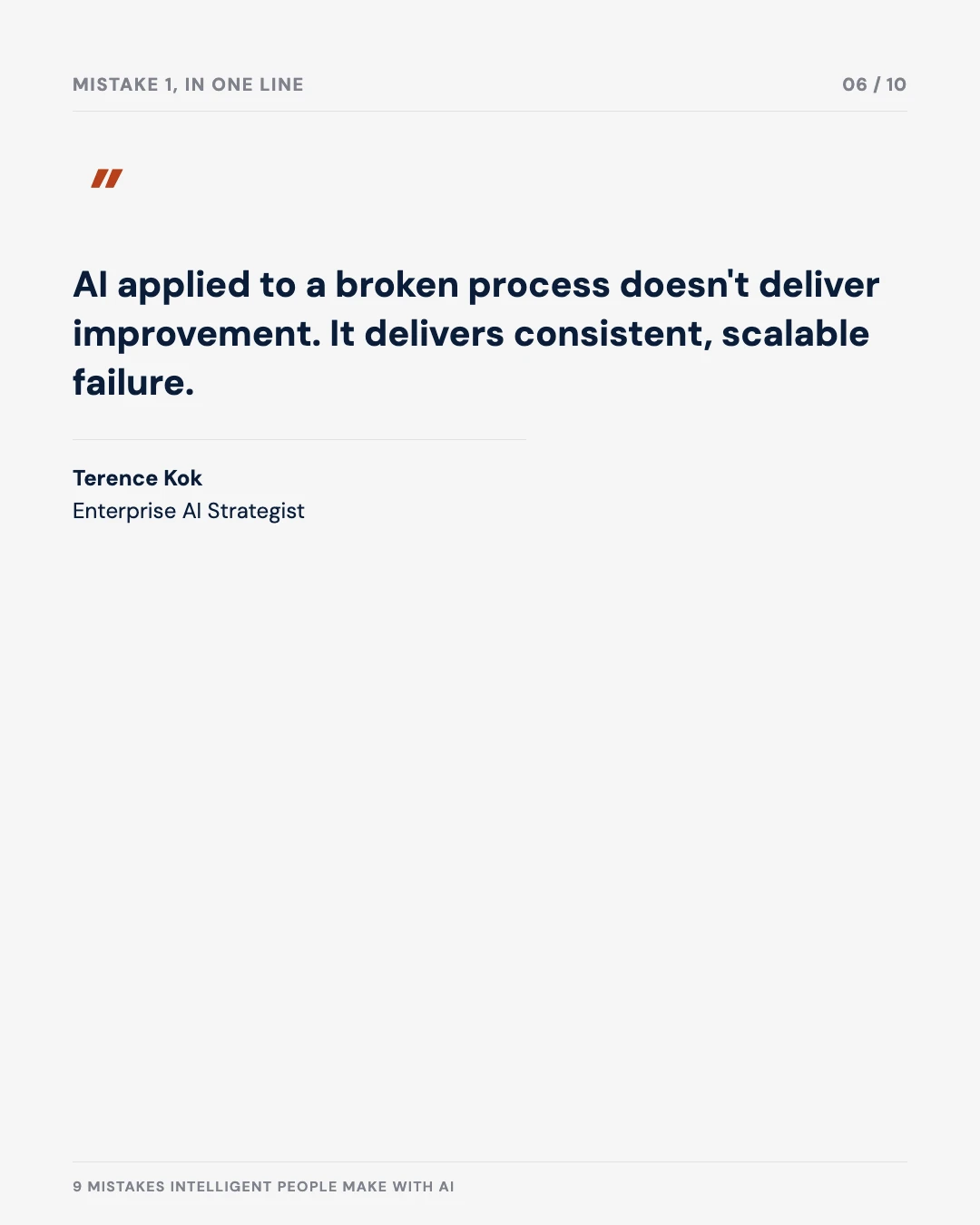
The fix: audit the process before you automate it. Map the decision points, identify the bottlenecks, and confirm it works. AI applied to a broken process doesn’t deliver improvement. It delivers consistent, scalable failure.
AI applied to a broken process doesn’t deliver improvement. It delivers consistent, scalable failure.
2. No way to know if it’s working
Adopting AI tools because they feel useful is not a strategy. Without a baseline and a clear metric, you have no way to tell if things have improved or gotten worse. This shows up as:
- A consultant using AI for proposals, but never checking whether the win rate, turnaround time, or client feedback changed. Consultants and agencies frequently track “adoption” or “activity” metrics (such as how many hours are saved by drafting with AI) rather than outcome metrics. In professional services, it is common for firms to report significant time savings (e.g., cutting a 25-hour proposal down to 5 hours) but fail to establish a baseline for whether those faster proposals convert at higher rates.
- A researcher using AI to surface papers, but not measuring whether the results are relevant or comprehensive. AI search and Q&A tools (such as ScienceDirect or Scispace) rely on opaque reasoning. They generate highly confident, polished lists of papers that may suffer from algorithm-induced confirmation bias, making researchers feel they have “done the work” without providing true directional clarity.
- A manager automating task assignments but never checking if deadlines, workload balance, or completion rates improved. Management expert Jerry Muller, in his book The Tyranny of Metrics , argues that leaders often fall into “metric fixation”, the belief that standardising and automating processes inherently equals good management. When a manager introduces automated task assignment but fails to monitor completion rates or balance, the system usually devolves into a performative box-ticking exercise. Employees often experience “burnout” as the algorithm blindly overloads certain team members while failing to address actual workflow bottlenecks.
Set a baseline before you deploy. Track it after. If you can’t measure it, you can’t manage it, and you won’t notice when it starts going wrong.
3. No one is reviewing the outputs
AI produces confident-sounding estimates, not facts. When you start treating the output as ground truth, errors compound silently until something breaks visibly.
- Financial analysis is accepted at face value, with investment decisions based on hallucinated figures. Most recently, bondholders sued Oracle over losses tied to AI infrastructure buildouts, though the case focuses more on undisclosed costs than on hallucinated analysis.
- AI-drafted legal documents filed without review, with compliance exposure discovered after the fact. The Mata v. Avianca Precedent (United States, 2023) This landmark case set the standard for AI accountability in the US. A New York attorney used an AI chatbot to draft a court submission without review. The AI “hallucinated” six entirely fictional cases with fake quotes and citations. The judge sanctioned the lawyers, establishing a clear precedent that attorneys are strictly liable for the accuracy of their filings, regardless of how the text was generated.
- Customer service responses were sent unreviewed, causing brand damage from responses that were technically fluent but factually wrong. Air Canada was held legally and financially liable by a Canadian tribunal after its unreviewed, generative AI customer service chatbot provided technically fluent but completely fabricated policy information to a passenger.
For anything with real consequences, keep a human in the loop. AI is a thinking partner, and the accountability for its output is still yours. Designing that oversight deliberately is the subject of Redesigning Oversight Architectures.
AI is a thinking partner. The accountability for its output is still yours.
4. Nobody is questioning what the model learned from
A model trained on skewed data will confidently produce skewed results at scale. If you don’t interrogate the inputs, you’ll mistake the model’s blind spots for insights.
- A recruiter whose AI screens CVs against historical data from a homogeneous hiring pool, systematically filtering out strong candidates. Plaintiff Derek Mobley applied to over 100 jobs that used Workday’s AI screening tools and was rejected by all, often within minutes. He argued that Workday’s screening algorithms baked in systemic algorithmic bias, creating a “disparate impact” that screened out qualified candidates who were Black, older than 40, or had mental health conditions. Workday tried to dismiss the case by arguing they are just a software tool, not the actual employer. However, US District Judge Rita Lin rejected this defense. In a historic ruling, the court certified the case as a collective action, declaring that AI software vendors can be held legally liable as an “agent” of the employer if they perform screening functions that historically belonged to humans.
- A sales team whose AI prioritises leads based on past deals misses high-value segments that don’t match the historical pattern. When a highly lucrative, fast-growing new segment emerges, the AI assigns it a critically low lead score . Because sales reps only chase high-scoring leads, these hyper-growth inbound accounts are ignored, routed to automated email sequences, or dropped entirely. Consequently, competitors who rely on human market intuition capture the new segment. See case here.
- A content team whose AI keeps recommending the same topics to the same audience, reinforcing existing preferences. TikTok’s Over-Personalization Trap. TikTok’s recommendation engine is highly efficient at capturing immediate micro-preferences. However, teams managing brand channels on TikTok frequently hit an “audience ceiling.” If a brand’s video about “Topic A” performs well, the AI targets it exclusively to a hyper-specific pocket of users. If the brand tries to branch out to “Topic B,” the algorithm struggles to find an audience because it has pigeonholed the account’s content DNA.
Ask where the training data came from. Who was included? What was excluded? If you can’t answer that, you don’t fully know what you’re deploying.
5. No way to tell why something broke
Most people set up an AI workflow and never build in any way to see inside it. When something goes wrong, troubleshooting becomes guesswork:
- An automated workflow fails mid-process, with no record of which input triggered it or where it went wrong. When an automated workflow makes an API call to a third-party service, the third-party server can crash or drop the connection without sending back a failure status code. The workflow simply hangs and terminates.
- Output quality gradually degrades, but there’s no monitoring in place, and nobody notices until a client points it out. Within the AI lifecycle, a model is often evaluated against benchmarks and performs well at deployment. However, over time, phenomena known as Model Drift or Agentic Drift can occur. This happens because the real-world data the AI processes gradually diverges from the historical data it was trained on. For models integrated with third-party APIs (such as OpenAI or Anthropic), the underlying proprietary models are frequently updated by the provider, which can change output formats or reasoning behaviours without the developer’s awareness. Over time, the model’s output quality can decline.
- Two tools stop communicating intermittently, but with no logs, there’s no pattern to debug. Three recurring causes are worth naming individually:
- Token Window Context Decay: as the conversation or execution trace grows, the LLM’s context window fills. If the system lacks an automatic memory management routine (such as context trimming), the model’s internal representation of tool definitions can degrade. It may “forget” how to format arguments or hallucinate arguments that the receiving tool doesn’t recognise.
- The “Happy Path” Trap: tool integrations (such as an LLM executing API calls) work perfectly in controlled demos. However, they often fail under boundary conditions, with empty payloads, or with null values without throwing an exception. The LLM catches the empty return and silently ignores it instead of re-prompting or fixing the error.
- State Drift & Race Conditions: in a multi-agent or asynchronous pipeline, one sub-agent may assume the previous tool has completed its task based on latency limits. If Tool A experiences a 5-second network delay, Tool B (the LLM) might generate a response assuming Tool A failed, resulting in desynchronisation. Because the network didn’t “crash” and the tools were technically responding, no error was logged.
Build in visibility before you need it . Because by the time something fails badly, it’s too late to wish you had the audit trail.
Build in visibility before you need it. By the time something fails badly, it’s too late to wish you had the audit trail.
6. Using AI to replace expertise that doesn’t exist
AI accelerates what you already know how to do. It doesn’t compensate for what you don’t. Delegating decisions you can’t evaluate is where things get dangerous:
- A product manager using AI to prioritise features without understanding customer behaviour ends up optimising the roadmap for the wrong things. After partnering with IBM to integrate AI into drive-thrus, McDonald’s abruptly scrapped the project. The root issue was failing to accommodate actual human behaviour; the model struggled to understand conversational nuances, accents, and order modifications, ultimately creating customer friction instead of value.
- A legal professional relying on AI contract review without knowledge of contract law may miss key obligations because no one caught them. The landmark precedent for this is Mata v. Avianca, Inc. in 2023 . In this case, a lawyer used a generative AI tool (ChatGPT) to conduct legal research for a court brief. The AI “hallucinated” several fictitious cases that sounded perfectly real and plausible. Because the attorney did not verify the AI’s work, he submitted the brief containing these fake precedents to the judge. The judge ultimately sanctioned the attorneys, emphasising that a lawyer’s duty of competence requires them to verify the accuracy of any work generated by AI tools.
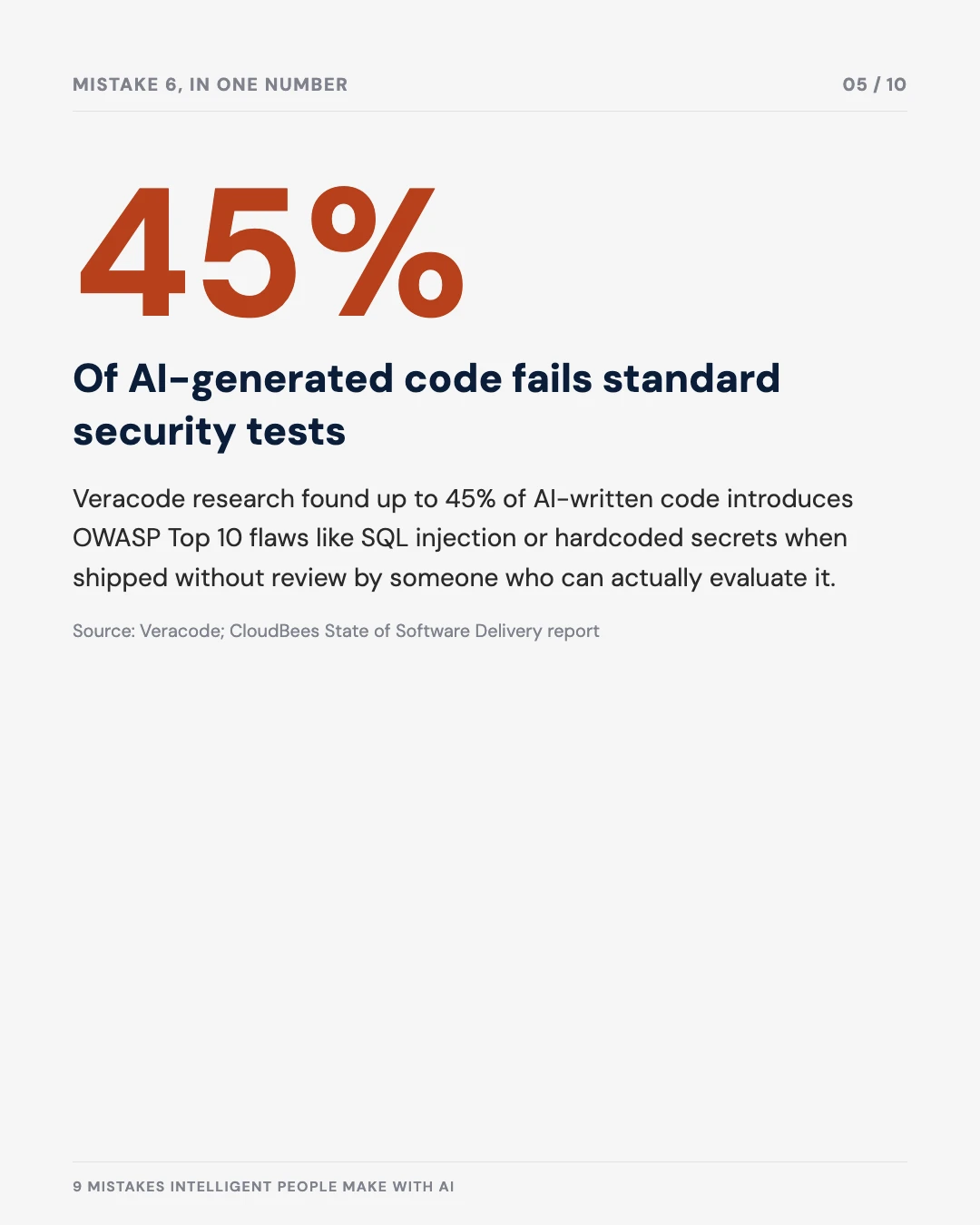
- An engineer shipping AI-generated code without reviewing the logic would introduce vulnerabilities and edge cases that reach production. Research by Veracode revealed that up to 45% of AI-generated code fails standard security tests, often introducing OWASP Top 10 flaws like SQL injection or hardcoded secrets. The “Vibe Coding” Trap : Recent post-mortems in the CloudBees State of Software Delivery report note that 81% of enterprise technology leaders link production issues directly to AI-generated code that was accepted without rigorous verification.
AI is a multiplier. If the underlying capability isn’t there, there’s nothing to multiply.
7. AI increased busyness instead of reducing it
This is the one that surprises people most. AI can absolutely increase your total workload if you deploy it without rethinking the surrounding process. The output volume goes up; so does the review burden:
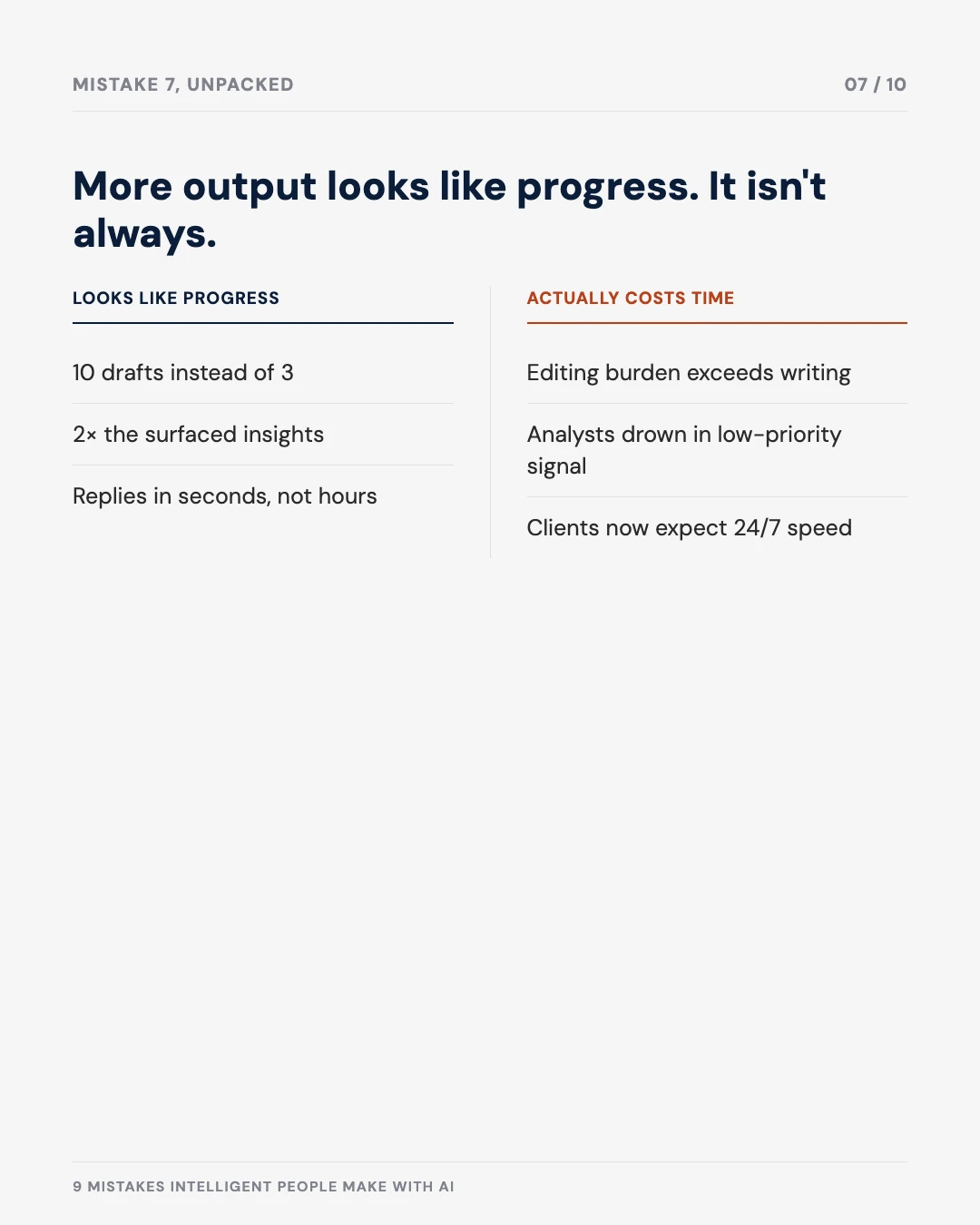
- AI generates 10 drafts where you used to write 3, and each still needs editing, so total time spent goes up. AI initially reduces cognitive effort by accelerating drafting, creating an illusion of increased efficiency; however, it shifts the challenge to editing, which can be more taxing and time-consuming than writing itself. Investing time in crafting prompts and generating multiple drafts can lead to the sunk-cost fallacy, making users feel compelled to refine an already imperfect output. Editing AI-produced text can be more difficult than writing from scratch, as it involves identifying errors, revising generic or robotic phrasing, and adapting the AI’s standardised tone to one’s personal style. Additionally, the paradox of choice emerges when AI provides multiple options (different outlines or code snippets, say), prompting users to spend excessive time comparing and selecting the “best” or least flawed version.
- Automated data pipelines surface twice as many insights, but with no filtering, analysts drown in low-priority signals. In the mid-2010s to 2020s, Security Information and Event Management (SIEM) systems began automatically ingesting billions of logs and surfacing thousands of “threats” per day. Without proper upstream filtering or correlation, Tier 1 analysts were drowning in false positives and missing up to 30% of actual, critical attacks.
- Faster AI responses raise client expectations, increase message volume, and demand more human time than before (not less). When AI reduces the time it takes to get an answer or generate content from hours to seconds, clients stop viewing speed as a luxury and start viewing it as the new baseline. Because the cost of asking is now effectively zero, clients reach out more often, ask more complex variations of questions, and expect 24/7 hyper-personalisation.
Net time saved is the goal, measured across the whole task end-to-end, including the review and correction cycles.
8. Picking the popular tool over the tool that fit
Much of AI tool adoption is driven by hype. The result: time wasted on tools that were never right for the job:
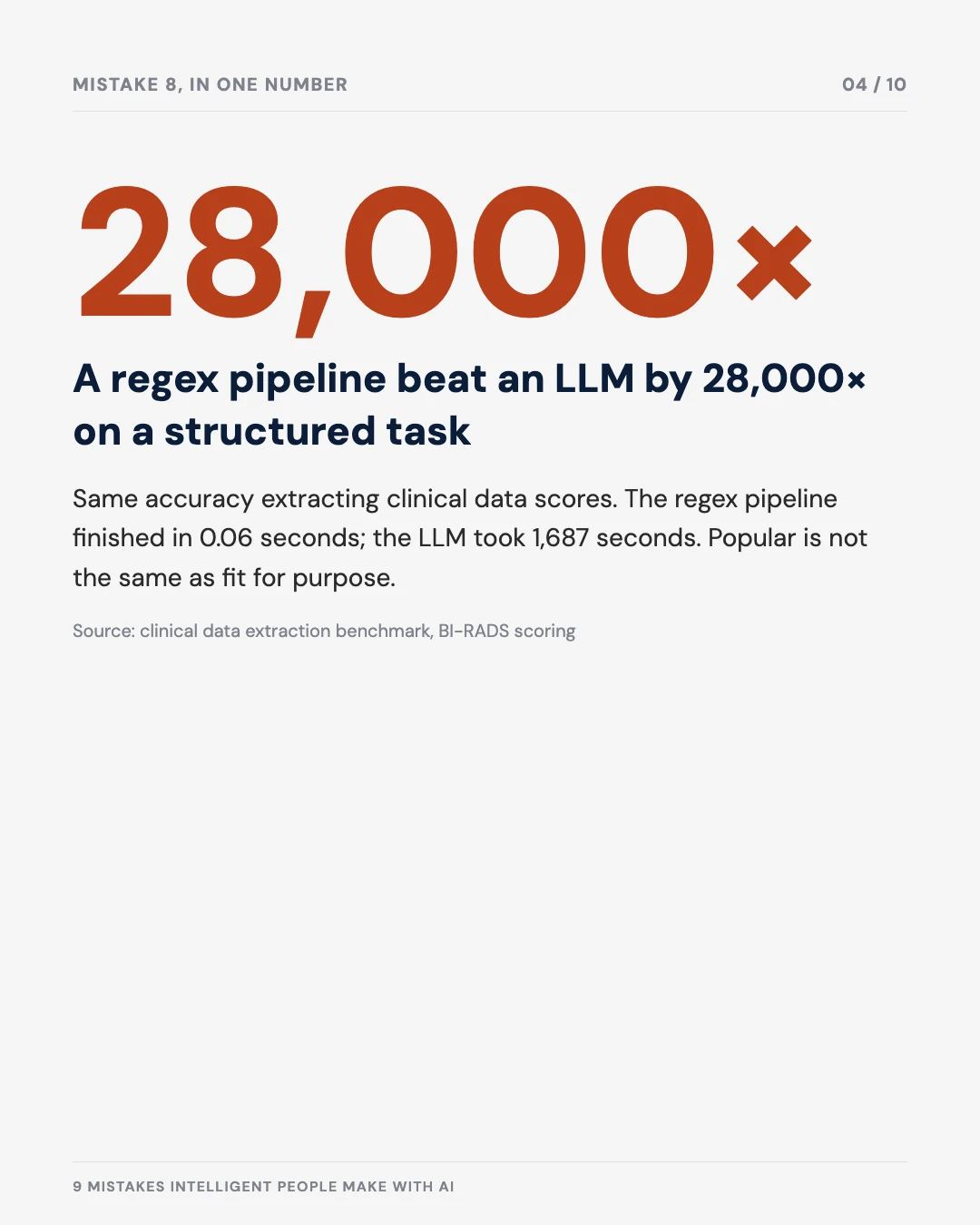
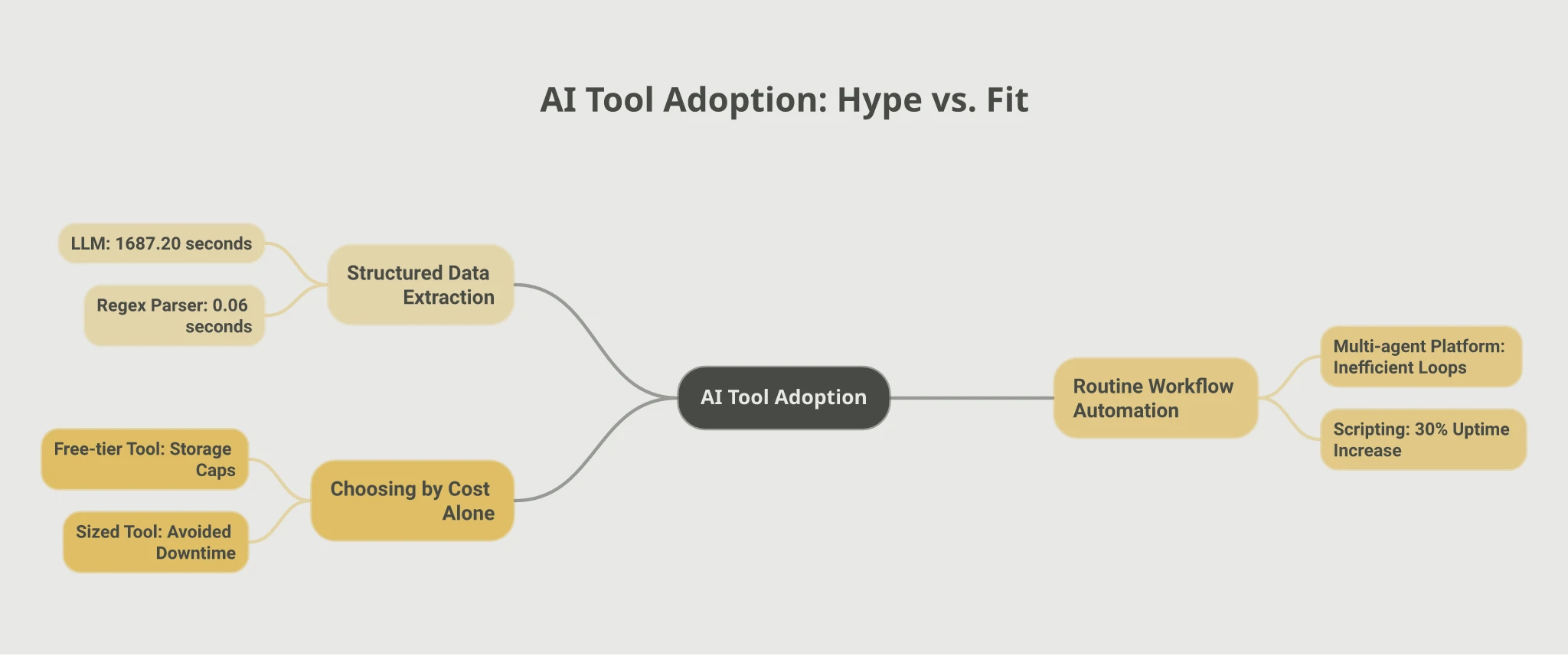
- Using a general-purpose LLM for structured data extraction when a purpose-built parser would be faster and more accurate. Clinical Data Extraction: In a medical study benchmarking regular expressions (RegEx) against LLMs for extracting BI-RADS scores from radiological reports , researchers found no significant difference in accuracy. However, the RegEx pipeline was over (28,000) times faster (completing the task in 0.06 seconds compared to 1687.20 seconds for the LLM).
- Deploying a complex multi-agent platform for a workflow that basic scripting would handle with less overhead and more reliability. A logistics firm reverted from autonomous agents to workflow automation (scripting) with human review , which improved system uptime by 30%. The agents had introduced “invisible crashes” where they didn’t technically fail but drifted into inefficient loops.
- Choosing a free-tier tool for cost reasons, then hitting usage limits at exactly the wrong moment. Developers routinely rely on free-tier databases for their initial traction phase. There are numerous documented cases in the developer community of hobby apps or AI side projects going slightly viral, quickly exhausting the 1 GB storage or concurrent connection limits, and immediately triggering an automatic “project paused” or read-only status, causing temporary downtime. Professionals increasingly using free-tier Large Language Models (like Anthropic’s Claude or OpenAI’s ChatGPT) for heavy workloads or code-generation report hitting strict token caps exactly in the middle of a critical client deadline. The models then become temporarily unusable or restrict users to slower, less capable base models.
Define the requirements first: latency, accuracy, scale, security, and integration. Then pick the tool that fits.
9. The system is failing, unnoticed
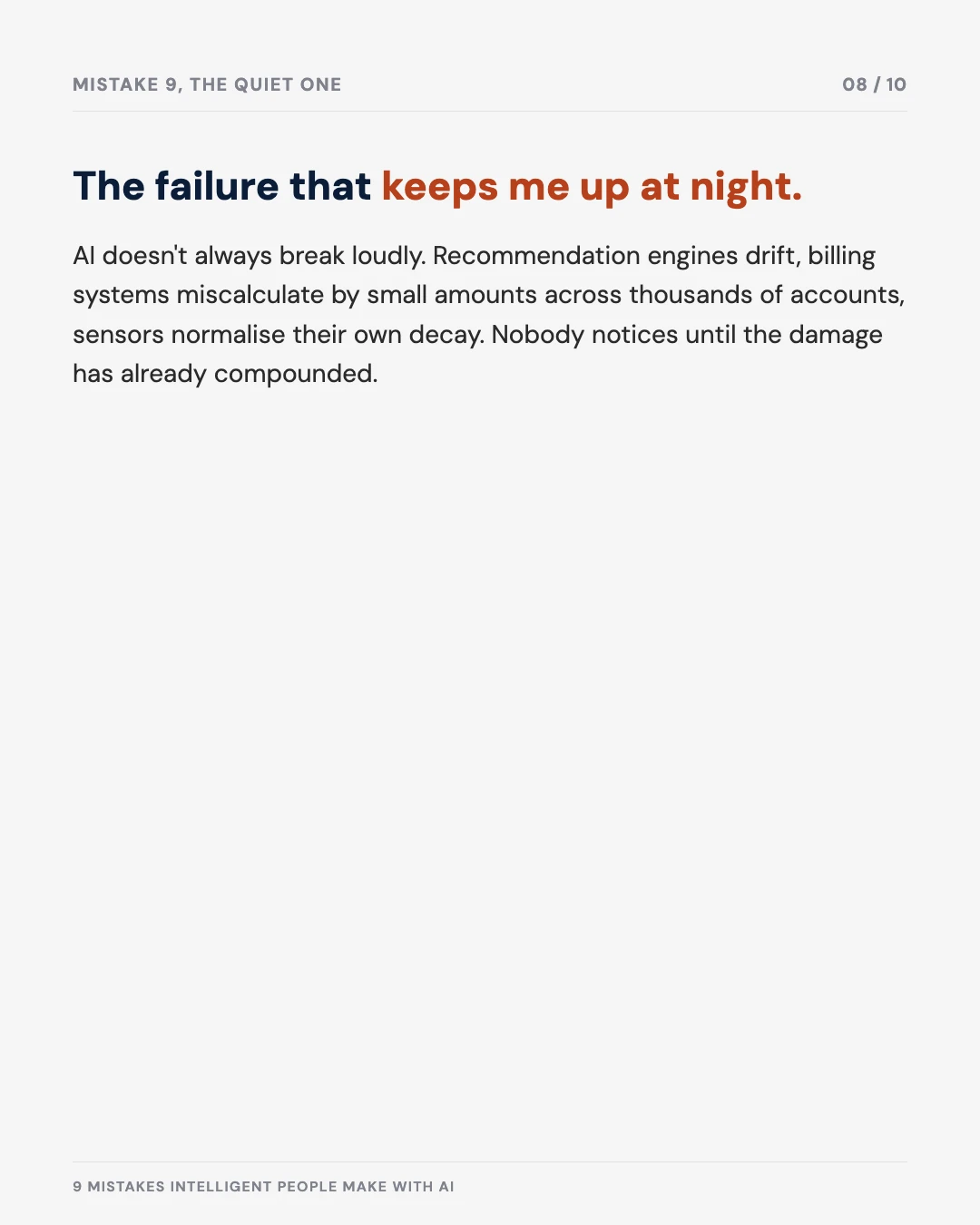
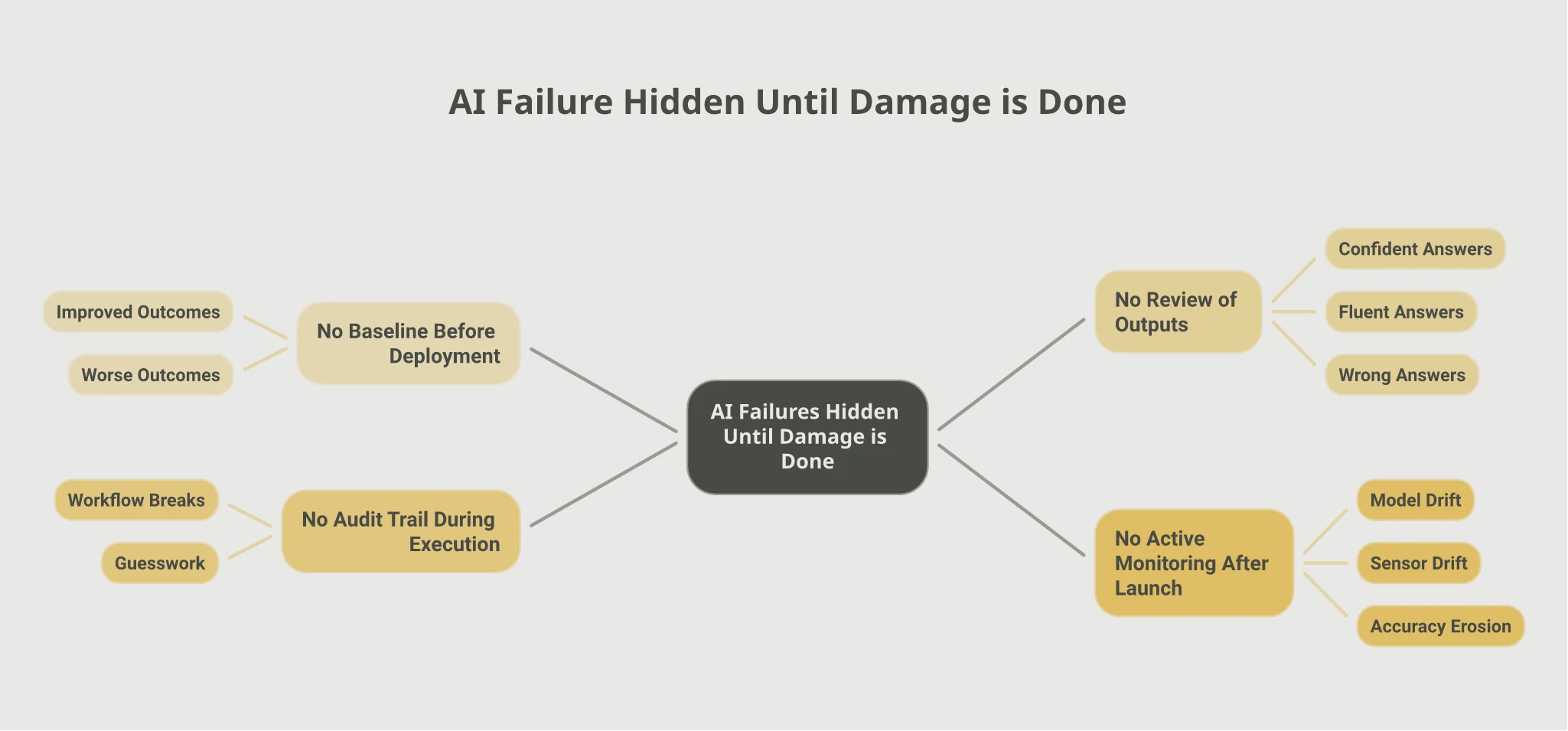
This is the failure mode that keeps me up at night. AI doesn’t always break loudly. It often continues to run perfectly while producing outputs that are subtly and gradually wrong. Nobody notices until the damage is done:
- A recommendation engine drifts towards lower-quality content, where engagement declines slowly enough that no one flags it as a system problem. Predictive maintenance (PdM) algorithms learn to establish a normal operating range. If a vibration or temperature sensor slowly drifts due to ageing or environmental wear, the system adjusts its baseline. Consequently, when an actual mechanical defect begins to form, the signal gets “subtracted out” because the sensor is no longer reading the true physical state.
- A billing system miscalculates invoices, and the errors are small enough that most customers don’t complain, but they’re compounding across thousands of transactions. In 2023, the Los Angeles Department of Water and Power (LADWP) suffered a massive billing system disaster caused by defective software implementation. The flawed system applied incorrect rates and miscalculations across hundreds of thousands of accounts. The small but widespread errors compounded over the years, ultimately resulting in a massive class-action settlement.
- A predictive maintenance system often fails to detect early equipment faults because sensor drift occurs over months, leading to unexpected outages. In power generation and manufacturing, vibration and thermal sensors can undergo calibration shifts due to prolonged exposure to harsh environments. If the data pipeline considers this sensor degradation as normal variation, the model overlooks early fault indicators, such as bearing wear. Once the equipment physically deteriorates beyond repair, it results in a sudden, catastrophic outage with no prior warning.
Active monitoring isn’t optional once you’re running AI at scale. Silent failure of exactly this kind is what keeps me up at night about AI, more than any dramatic failure scenario. Set thresholds. Build alerts. Review outputs regularly, not because you expect failure, but because silent failure is exactly what you won’t expect.
Silent failure is exactly what you won’t expect.
The technology is powerful. But power without structure creates risk. The professionals and organisations who will get the most from AI over the next decade aren’t necessarily the fastest adopters; they’re the most intentional ones.
Evidence & Methodology
These nine mistakes do not all rest on the same kind of proof. Some are peer-reviewed studies, some are court rulings, one is simply what I have watched happen for years across client work. Here is one example of each kind.
| Claim | Source | Grade |
|---|---|---|
| Up to 45% of AI-generated code fails standard security tests | Veracode’s 2025 GenAI code security report | Measured |
| A regex pipeline matched an LLM’s accuracy on a clinical extraction task while running 28,000 times faster | Dennstädt et al., 2025, peer-reviewed comparison published in JAMIA Open | Measured |
| Unreviewed AI output has already created real legal and financial liability, not just reputational risk | Documented cases: Mata v. Avianca, Mobley v. Workday, and the Air Canada chatbot ruling | Court record |
| These nine failure modes are the recurring ones, in this order of frequency | My own pattern from working with teams across industries, not a controlled study | My call |
Sources
- Dennstädt, F., et al. (2025). A comparative performance analysis of regular expressions and a large language model-based approach to extract the BI-RADS score from radiological reports. JAMIA Open.
- Veracode. (2025). GenAI code security report.
- CloudBees. (2026). The 2026 state of code abundance.
- Muller, J. Z. (2018). The tyranny of metrics. Princeton University Press.
- JD Supra. (2024). Mobley v. Workday: Court holds AI service providers could be directly liable for employment discrimination under “agent” theory.
- Reuters. (2026). Oracle sued by bondholders over losses tied to AI buildout.
- CBC News. (2024). Air Canada found liable for chatbot’s bad advice on plane tickets.
Free tool
The Discipline Gap
Every mistake above traces back to a skipped step, not a bad model: this briefing lays out why that discipline gap is what stalls AI at scale.